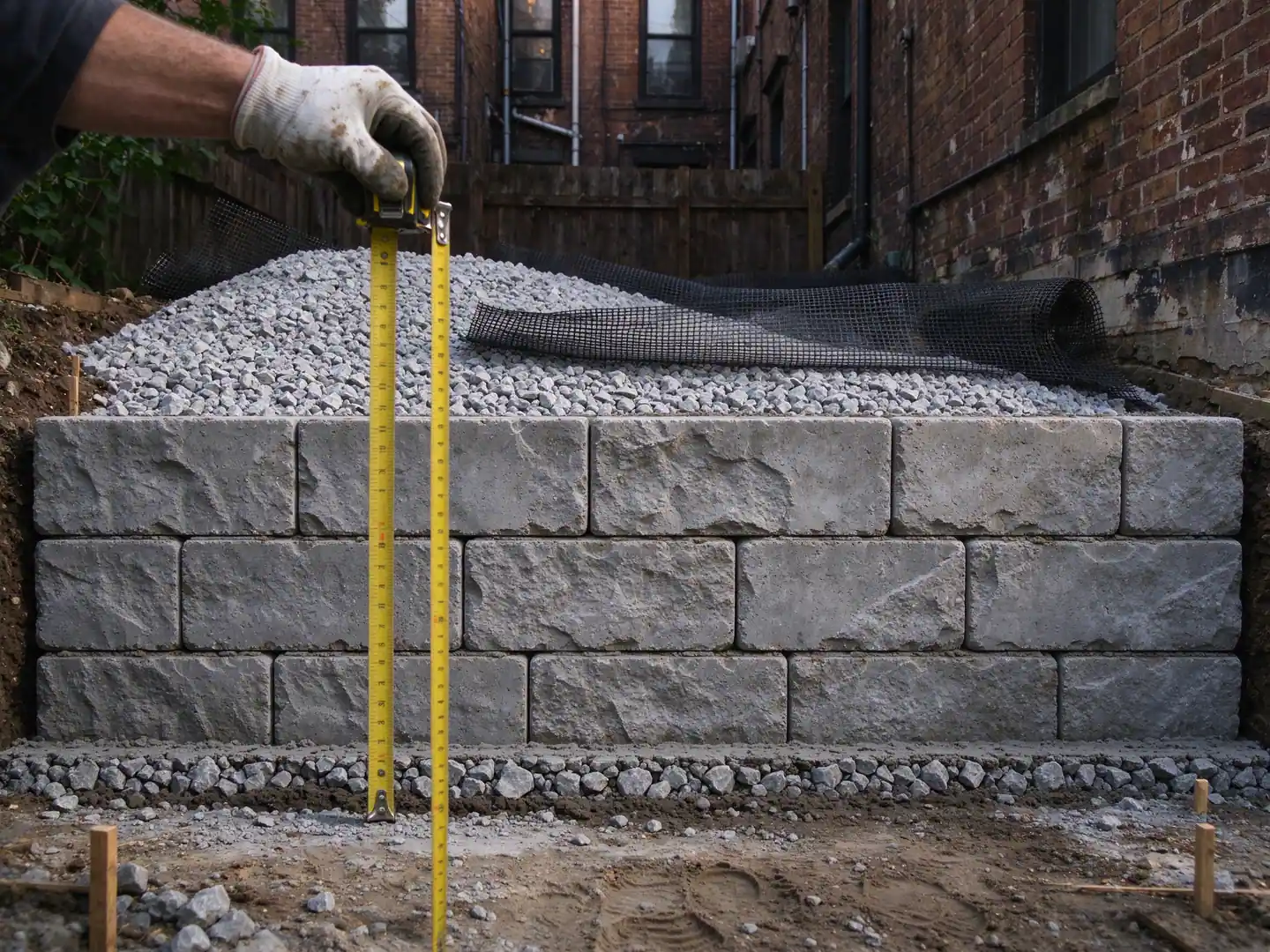
Yes, if the wall is 4 feet or taller measured from the top of the footing to the top of the wall, or if it supports a surcharge such as a driveway, a building or sloped ground. Those walls need a DOB permit with plans filed by a licensed engineer or architect (1 RCNY §101-14).
- No permit only if the wall is under 4 ft from the top of the footing AND supports no surcharge (1 RCNY §101-14).
- Permitted walls need plans filed by a registered design professional — a PE or RA (DOB).
- The 5-ft figure on many websites comes from 1 RCNY §101-18, which applies only to NYC Parks work.
- Engineering for walls over 4 ft: about $450–$970 in NYC (HomeAdvisor $350–$750 × RSMeans 129.1).
NYC Retaining Walls is a licensed and insured retaining wall contractor that builds permitted walls to engineer-stamped plans and coordinates the DOB filing. So, do I need a permit for a retaining wall in NYC? The rule is in 1 RCNY §101-14: a retaining wall needs no DOB permit only if it is less than 4 feet tall, measured from the top of the footing to the top of the wall, and it does not support a surcharge. Everything else needs a permit, with plans filed by a licensed engineer or architect before work starts. The retaining wall installation page covers how a permitted wall gets built.
Does my wall need a permit? Common cases
| Your wall | Permit? | Why |
|---|---|---|
| 3-ft garden wall, flat lawn above | No | Under 4 ft, no surcharge |
| 3-ft wall with a driveway along the top | Yes | A driveway is a surcharge at any height |
| 3-ft wall with steeply sloped ground above | Yes | Sloped backfill is a surcharge |
| 4-ft wall from top of footing, flat lawn | Yes | Meets the 4-ft threshold |
| 2-ft wall supporting a shed or building | Yes | A building is a surcharge |
| Rebuilding a 6-ft wall in the same spot | Yes | Height alone triggers it |
Measure from the top of the footing, not from the ground you see. A wall that shows 3 feet 6 inches above grade can be over 4 feet once the buried portion above the footing is counted.
Why do some sites say 5 feet?
Because they’re quoting the wrong rule. 1 RCNY §101-18 has more generous exemptions, including a 5-foot figure, but it applies only to NYC Parks Department work on Parks land. It doesn’t apply to private homeowners. For a private wall, the 4-foot rule in §101-14 controls, and DOB’s owner guidance says all other retaining-wall work needs a registered design professional to file plans before a contractor builds.
What does a surcharge mean?
A surcharge is any load on the retained side beyond flat soil: a driveway, a parking pad, a building, a pool or sloped ground rising behind the wall. It pushes on the wall in addition to the soil, which is why the code requires a permit at any height. If cars park within a few feet of the top of the wall, plan for a permit; see driveway retaining walls and hillside retaining walls.
What does the permit process cost and involve?
An engineer or architect designs the wall and files with DOB; the contractor builds to those plans. HomeAdvisor puts design for walls over 4 feet at $350–$750 nationally — about $450–$970 in NYC using the RSMeans index of 129.1 — plus DOB filing and permit fees. The retaining wall cost guide folds these into full project budgets, and the cost estimator switches engineering on automatically at 4 feet.
Are there other approvals beyond DOB?
Sometimes. In the Special Natural Area District — NA-1 Staten Island Greenbelt, NA-2 Riverdale, NA-3 Shore Acres and NA-4 Fort Totten — and in Staten Island’s Special Hillsides Preservation District (1987), regrading or building walls on steep lots can need City Planning review before DOB issues a permit. That matters on Riverdale and Grymes Hill lots in particular.
Does a permitted wall bring other obligations?
Two. A finished wall 10 feet or taller that fronts a public right-of-way enters the Local Law 37 inspection program, with a report every five years; see the Local Law 37 guide. And on a lot line, Admin Code §28-305.2 says the owner who changes the grade builds and maintains the wall on their own land at their own cost — DOB’s FAQ says you can’t simply backfill against a neighbor’s wall.
Do repairs need a permit too?
The same threshold applies to repairs. Repointing joints or resetting a cap on a 3-foot garden wall doesn’t need a filing. Anchoring a leaning 5-foot wall, rebuilding a section of a driveway wall, or adding drainage that means excavating behind a tall wall generally does, because the work is structural on a wall over the line. A wall rated Unsafe under Local Law 37 needs a permit for its repair, followed by an amended report. See retaining wall repair for the work and the repair cost guide for what permitted repairs cost.
Under 4 feet from the top of the footing with nothing loading it, you can build without a DOB permit; anything taller or carrying a driveway, building or slope needs stamped plans and a filing. To find out which side of the line your wall is on, (718) 555-0100.
Frequently asked questions.
How tall can a retaining wall be without an engineer in NYC?
Effectively, under 4 feet measured from the top of the footing to the top of the wall, with no surcharge on it. Once a wall reaches 4 feet, or supports a driveway, a building, a parked car or sloped ground, 1 RCNY §101-14 requires a DOB permit, and the plans must be filed by a licensed professional engineer or registered architect.
Do I need a permit to rebuild an existing retaining wall?
The same threshold applies to rebuilding as to building new. Replacing a 3-foot garden wall with nothing above it doesn't need a permit; rebuilding a 5-foot wall, or any wall along a driveway, does. Work on a wall rated Unsafe or SREM under Local Law 37 generally needs a permit as part of the repair, and the amended report follows the work.
What happens if I build a retaining wall without a permit?
DOB can issue violations and stop-work orders for unpermitted work, and an unpermitted wall can complicate a sale or an insurance claim later. The bigger risk is the wall itself: in December 2020, a 9-foot retaining wall in Sunset Park collapsed and killed a worker, and NY1 reported that no DOB permits had been issued for the work.