NYC Retaining Walls is a licensed and insured retaining wall contractor that handles retaining wall violation repair across all five boroughs: walls rated Unsafe or SREM in a Local Law 37 report, walls cited by the Department of Buildings after a complaint, and owners holding failure-to-file violations who need the wall fixed and the paperwork closed. Retaining wall violation repair is deadline work. An Unsafe condition must be corrected within 90 days of the report, a missed correction costs $1,000 a month, and the city's record of a collapse in Tremont in January 2024 shows what happens when repairs on a flagged wall never get filed. We read the report or violation, secure the wall, and schedule the fix so the inspector can sign off in time.
What we do on the first visit
Call as soon as you have the report or violation; the first visit is free and is scheduled first if the wall is Unsafe or has dropped material. Here's what happens:
- We read the paperwork with you — the QRWI's TR16 report and rating, or the DOB violation and its number — and write down every deadline it sets.
- We look up the property on the DOB Building Information System for other open violations, complaints, stop-work or vacate orders, and prior permits.
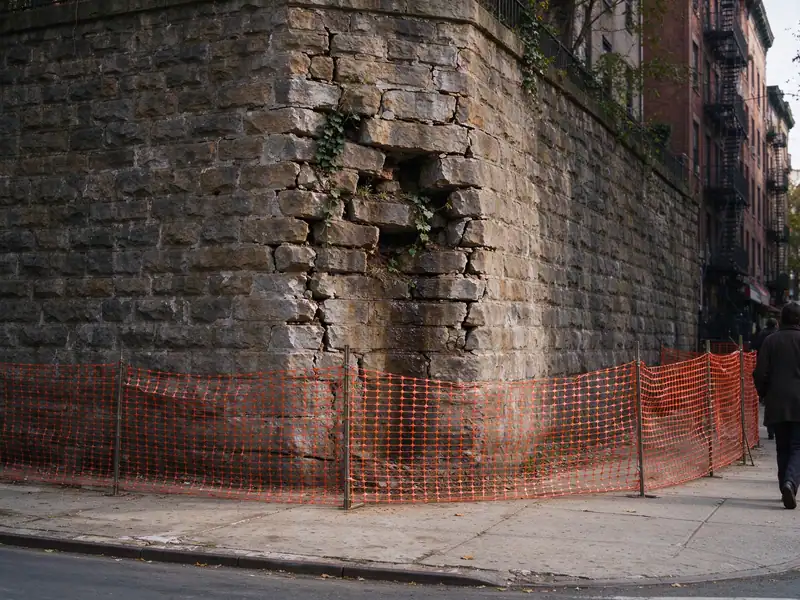
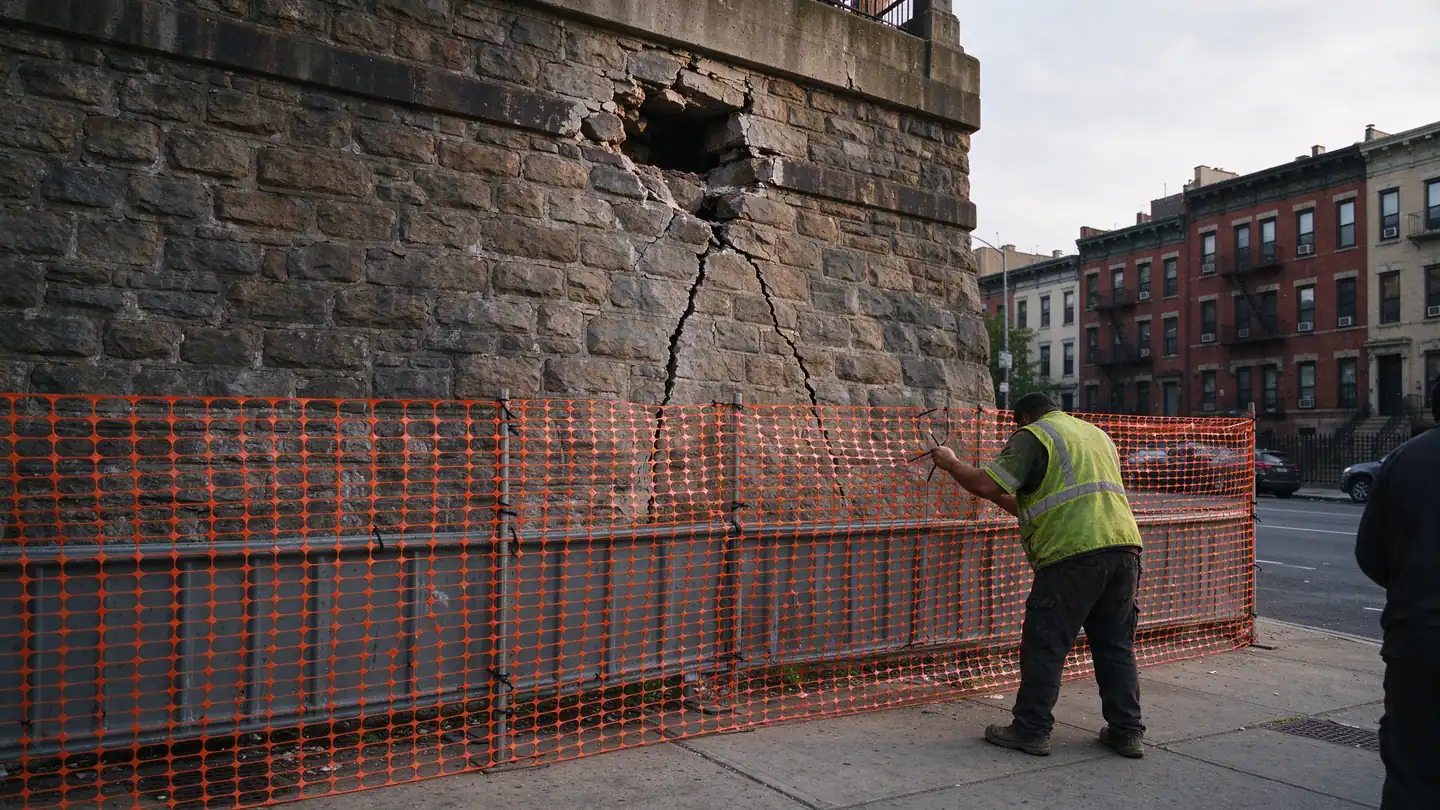
- We check public safety first. If the wall threatens a sidewalk, street, driveway or a neighbor's yard, we tell you what temporary protection the engineer is likely to require, such as fencing off the area at the toe of the wall.
- We walk the wall against the report, item by item, measuring lean, cracks, bulges and drainage at each location the inspector listed.
- You get a written scope and price keyed to the report's line items and its deadline, usually within two business days. For an Unsafe wall, we say on the visit whether the repair can realistically finish inside 90 days or whether an extension should be requested now.
Unsafe, SREM and DOB violations: what each one requires
Unsafe. The QRWI must notify the owner and DOB immediately by calling 311. The owner must secure the area at once, get a permit and start repairs, and monitor public safety until the repair is complete (Admin Code §28-305.4.6–4.7). The condition must be corrected within 90 days of the report filing (1 RCNY §103-09). If the work can't finish in time, an extension can be requested — DOB's fee is $260, and the application includes the repair contract. After the repair, the QRWI files an amended report ($130), due within two weeks of completion.
SREM — Safe with Repairs and/or Engineering Monitoring. The wall is safe for now, but repairs or monitoring are required within the timeframe in the report, which can't exceed one year. An SREM condition still uncorrected at the next inspection must be reported Unsafe, and that triggers a one-time $2,000 penalty on top of the Unsafe clock. Our SREM guide explains the rating.
Failure-to-file. The fix is an acceptable TR16 report, then the penalty sheet and payment. Since March 23, 2025 the penalty is $5,000 per year, plus $1,000 per month for late filing. Repairs the new report finds go on the same schedule as any other rating. If the wall isn't yours — it's the railroad's or a neighbor's — a signed and sealed survey is the way to contest it. See the failure-to-file guide.
How a neighbor's complaint becomes a violation
Not every violation starts with a Local Law 37 report. Anyone can call 311 about a wall that looks cracked, bulging or about to fall, and DOB logs it under complaint categories such as "Wall/Retaining Wall – Bulging/Cracked" and "Request for Retaining Wall Safety Inspection." A DOB inspector visits, and if the condition is confirmed, the owner can receive a violation that requires an engineer's evaluation and a permitted repair. Walls of any height can be cited this way; the 10-foot Local Law 37 threshold doesn't apply to a complaint.
Respond to it. A complaint that goes unanswered becomes a violation, and a violation that goes unanswered becomes penalties and, at worst, a vacate order. In the Anthony Avenue collapse in Tremont–Mount Hope on January 10, 2024, a partial vacate order had been in place since November 2020, DOB said repair applications were never filed, and a 150-foot section came down through an auto shop.
You can check a violation's status on DOB BIS by address or block and lot, or by emailing DOB's Local Law 37 unit at LL37RetainingWalls@buildings.nyc.gov. If the wall has already partly failed, start with what to do after a retaining wall collapse.
Repairs that clear the report
The repair has to answer what the report or violation actually says, and the QRWI has to be able to verify it. Typical scopes, smallest to largest:
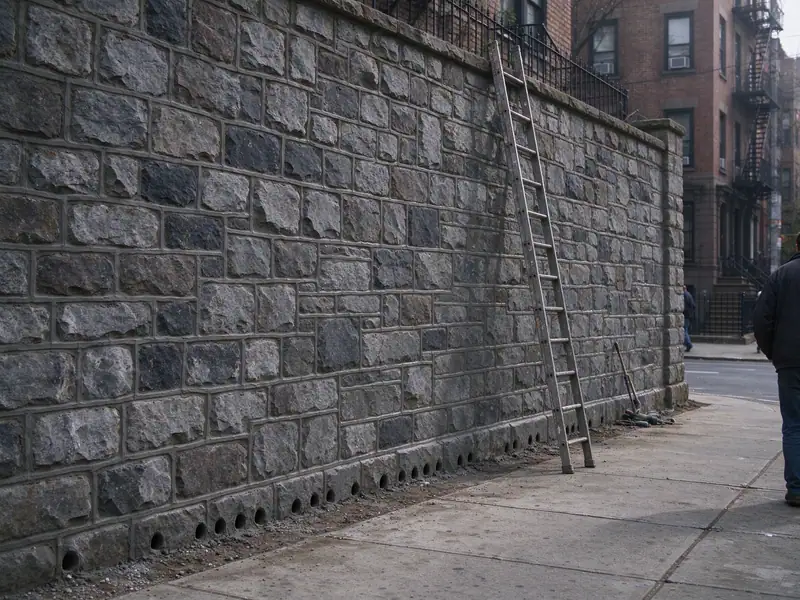
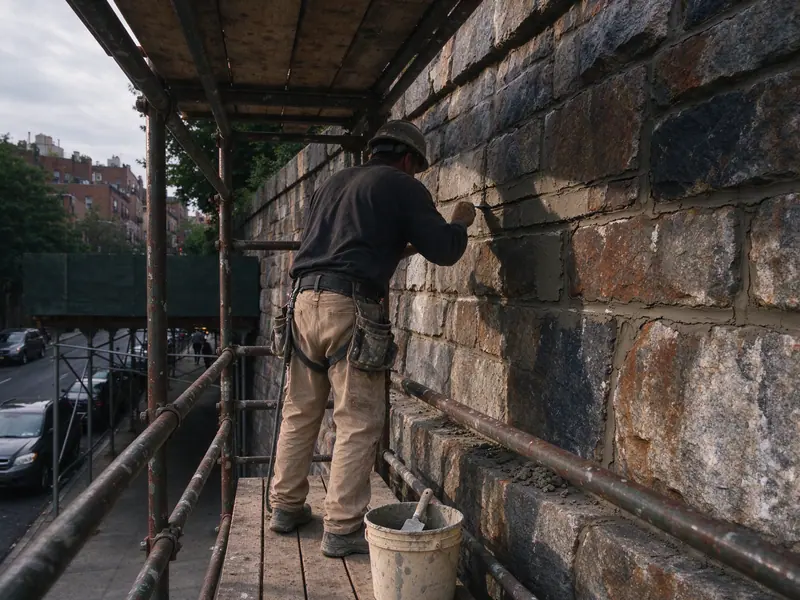
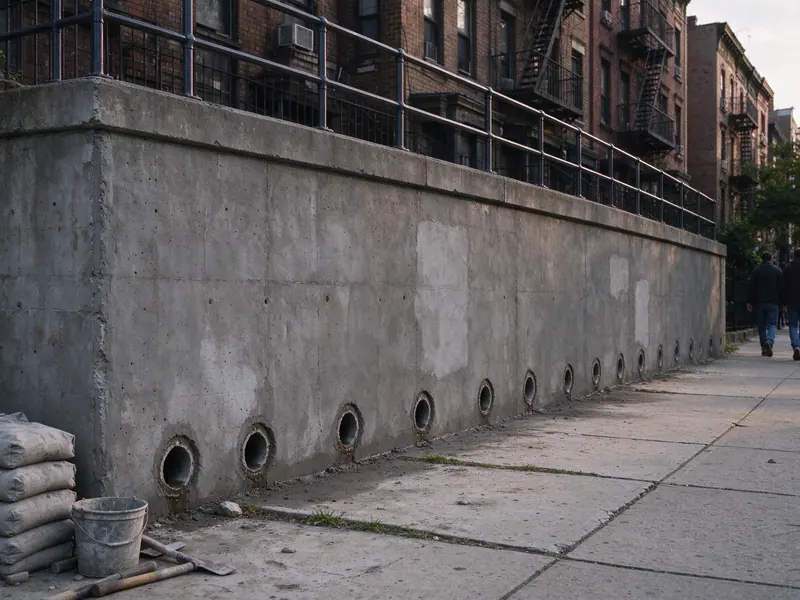
- Drainage and masonry items — clearing weep holes and drain outlets, removing vegetation rooted in joints, repointing, resetting loose stone, patching spalled concrete.
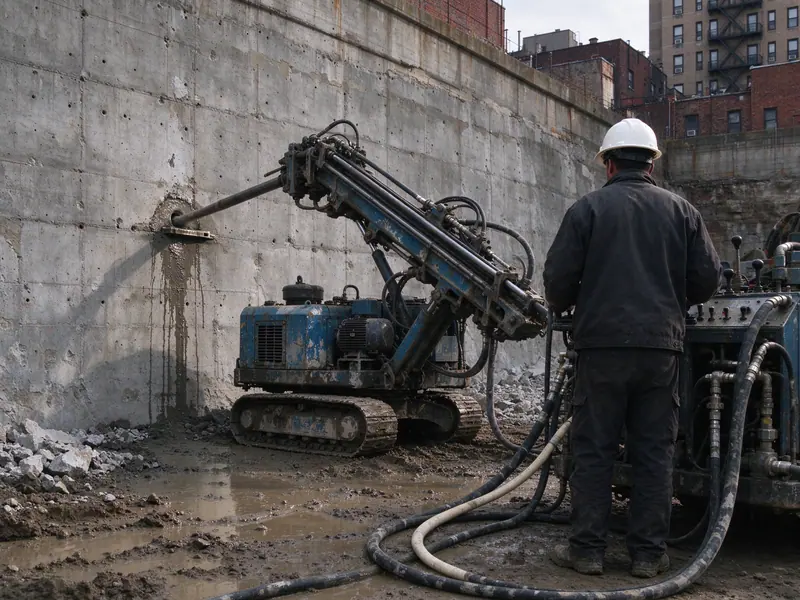
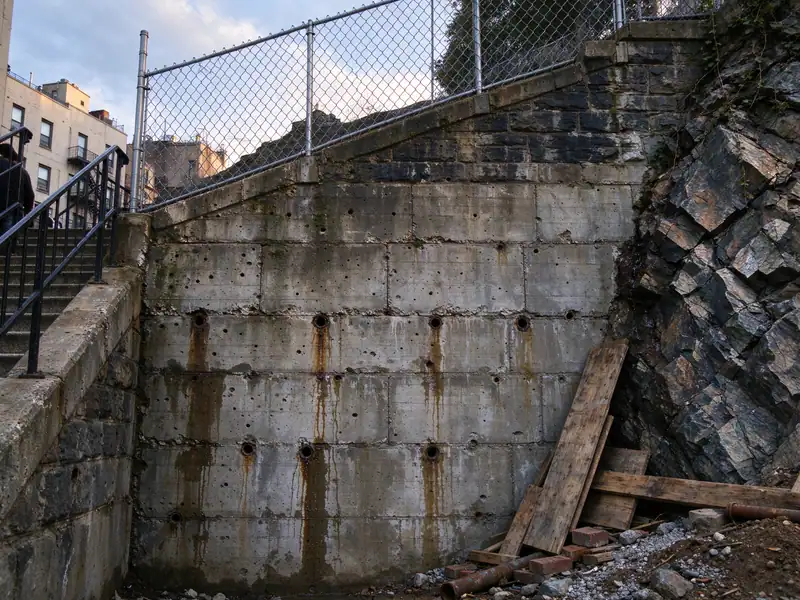
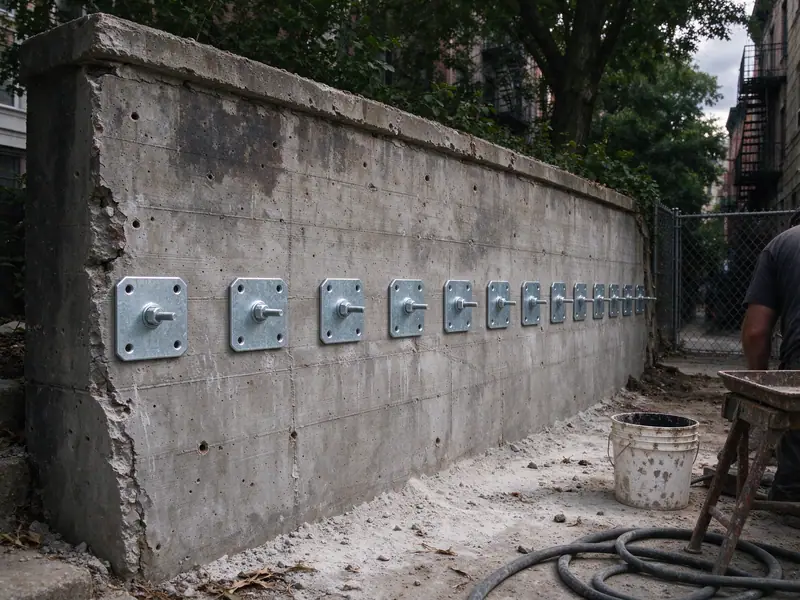
- Stabilization — helical anchors or tiebacks through a leaning or bulging wall whose body is still sound. See leaning retaining wall repair.
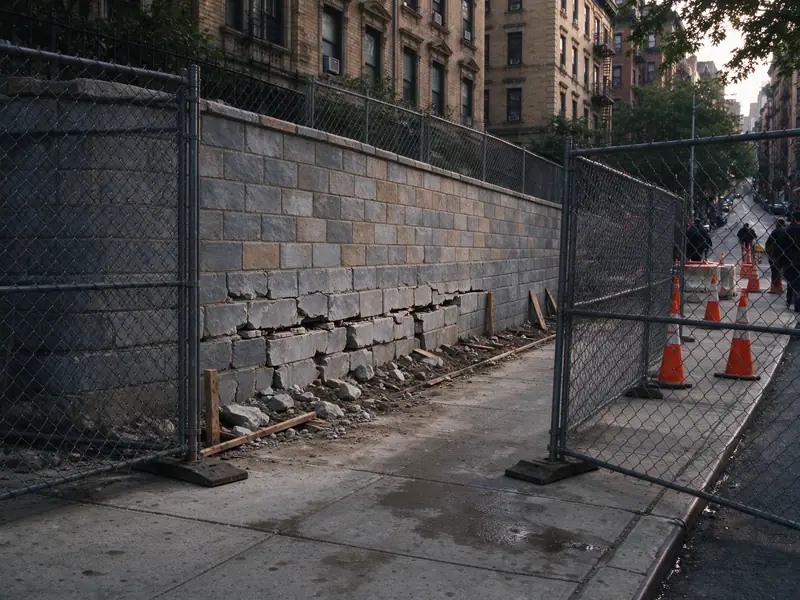
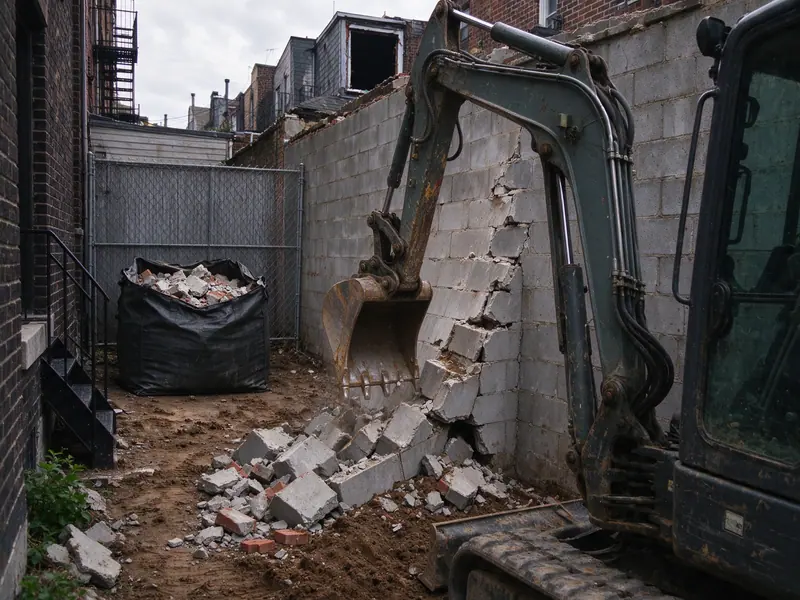
- Rebuild — partial or full retaining wall replacement when the footing, the wall body or the material has failed.
Anything structural is built to engineer-stamped plans under a DOB permit, which we coordinate. We photograph each repaired location against the report's numbering so the amended report is straightforward to prepare.
Costs, penalties and paying for the repair
The repair price depends on what the report requires. On NYC-adjusted national figures (Fixr, January 2025, × RSMeans NYC index 129.1), minor repairs typically run about $325–$1,600, anchoring about $75–$105 per linear foot, and a rebuild about $90–$160 per linear foot. Engineering for a permitted repair typically adds about $450–$970 (HomeAdvisor, × 1.29). DOB's fees are fixed: $130 for the amended report and $260 for an extension request.
Compare those with the penalties for waiting: $1,000 a month for an Unsafe condition left uncorrected, and $2,000 when an SREM item is ignored until the next cycle. Homeowners insurance usually excludes deterioration, earth movement and water pressure, so most violation repairs are paid directly; a sudden event such as a vehicle strike may be covered under Other Structures.
Every job gets a written contract with scope, price and payment schedule before work starts, as New York's General Business Law §771 requires for home improvement work over $500 — and that contract is the document an extension application asks for.
What's included
- ✓Priority site visit for Unsafe ratings and dropped material
- ✓Deadline sheet built from your report or violation
- ✓DOB records check for complaints, orders and permits
- ✓Temporary protection planned with the engineer
- ✓Scope and price keyed to the report's line items
- ✓Repair contract for an extension application
- ✓Engineer and DOB permit coordination
- ✓Photos by report location for the amended report
DIY vs. cheap operator vs. a wall built properly
| Factor | DIY | Cheap operator | Built properly |
|---|---|---|---|
| Drainage behind the wall | Native soil backfill | A little gravel, no pipe | 12 in+ of clean crushed stone, filter fabric, perforated pipe that daylights |
| Footing | Set on topsoil or sod | Shallow, uncompacted | Compacted base, sized and set below the frost line to the design |
| Reinforcement | None | None | Geogrid or rebar to an engineer's design where height and load call for it |
| Permit and engineer (walls 4 ft+ or surcharged) | Skipped | Skipped or "not needed" | Stamped plans and a DOB filing |
| Local Law 37 (10 ft+ on a right-of-way) | Unknown | Ignored | Built and documented so the QRWI report goes smoothly |
| Paperwork you keep | None | A handwritten estimate | Written contract, line-item scope, closeout photos |
| Where it usually fails | First freeze-thaw seasons | Within a few years, at the drainage | Designed to carry its load for decades |
What this work looks like