NYC Retaining Walls is a licensed and insured retaining wall contractor that handles retaining wall drainage repair across all five boroughs — clogged weep holes, drain pipes that silted up or never daylighted, and walls built with dirt instead of drainage stone behind them. Retaining wall drainage repair is often the cheapest fix that actually stops a wall from moving, because water is frequently the load that tips it. Soil that can't drain gets heavier, and the water in it pushes on its own: a saturated 6-foot wall carries roughly 1,100 pounds of water pressure per linear foot on top of the soil load (½ × 62.4 lb/ft³ × (6 ft)²). Take the water away and that load goes with it.
What we do on the first visit
The first visit is free and takes about 45 minutes. Ideally we see the wall within a day of heavy rain, but we can read most drainage problems dry:
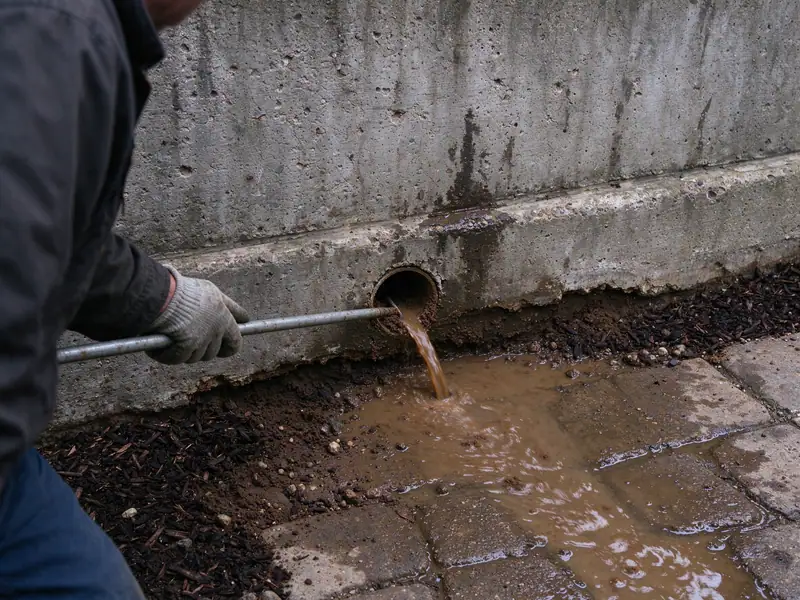
- We find the outlets. Weep holes, the end of any perforated pipe, and where that pipe is supposed to discharge. We check whether they're open, silted, crushed or buried.
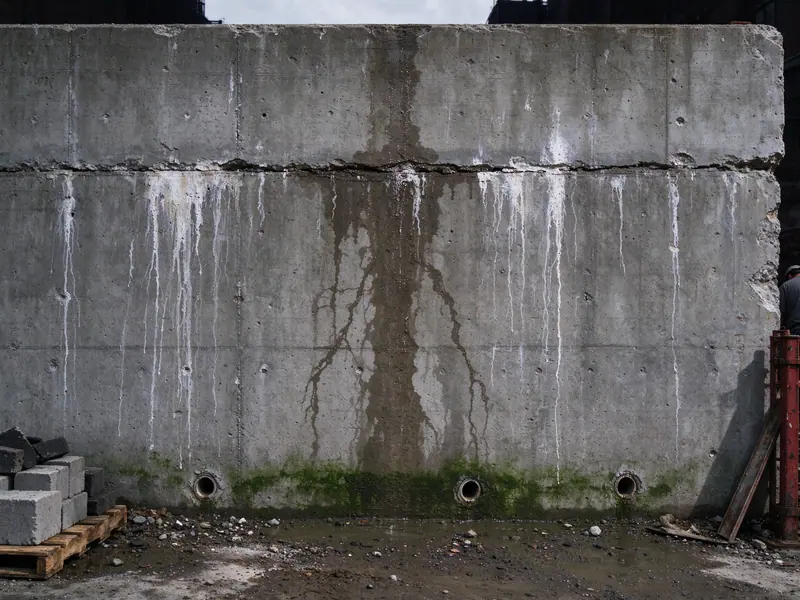
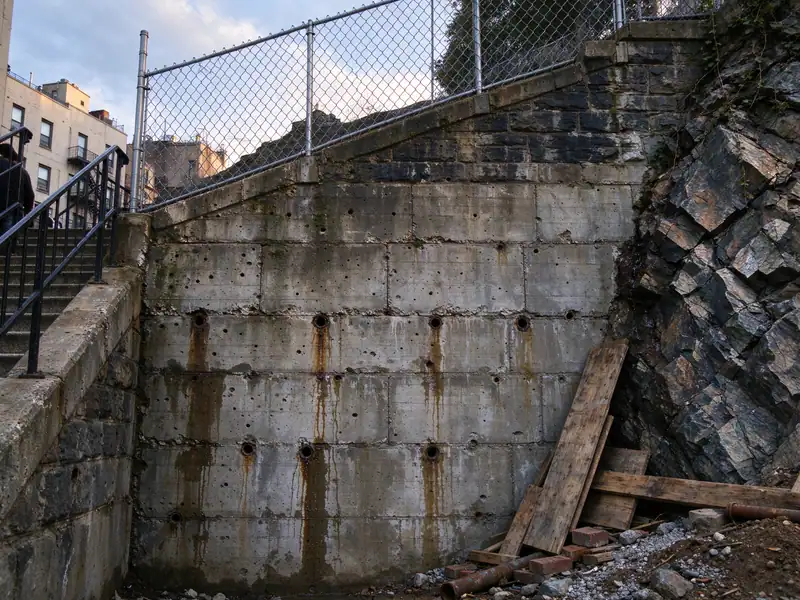
- We read the face. Wet patches, white efflorescence, green growth and rust staining show where water is coming through the wall instead of out of the drains.
- We check the toe and the top — soil washing out at the base, ponding or soft ground behind the wall, and cracks in the soil or paving above it.
- We trace the water sources — roof leaders, driveway and patio runoff, a neighbor's yard, a slope above, or groundwater.
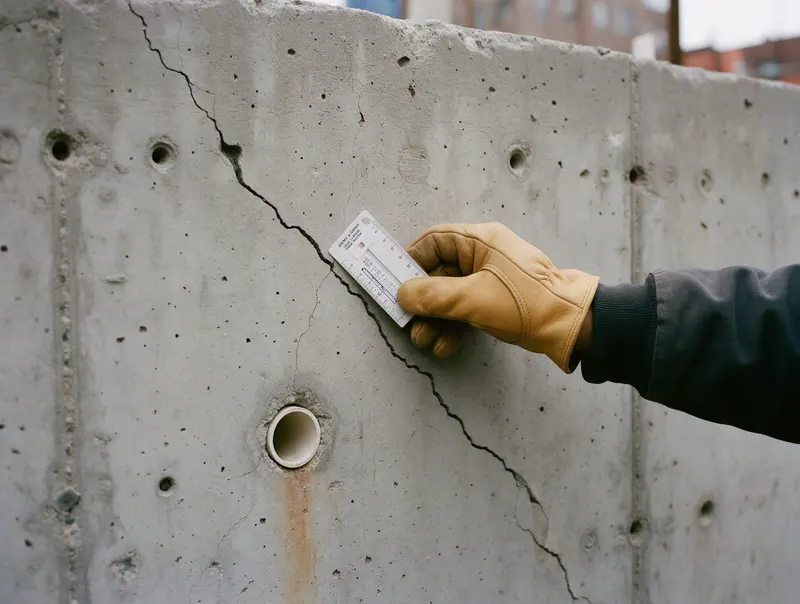
- We measure lean and cracks, because a wall that has already moved may need more than drainage; see leaning retaining wall repair.
- You get a written scope and price, usually within two business days.
How retaining wall drainage is supposed to work
A properly drained wall has four parts working together:
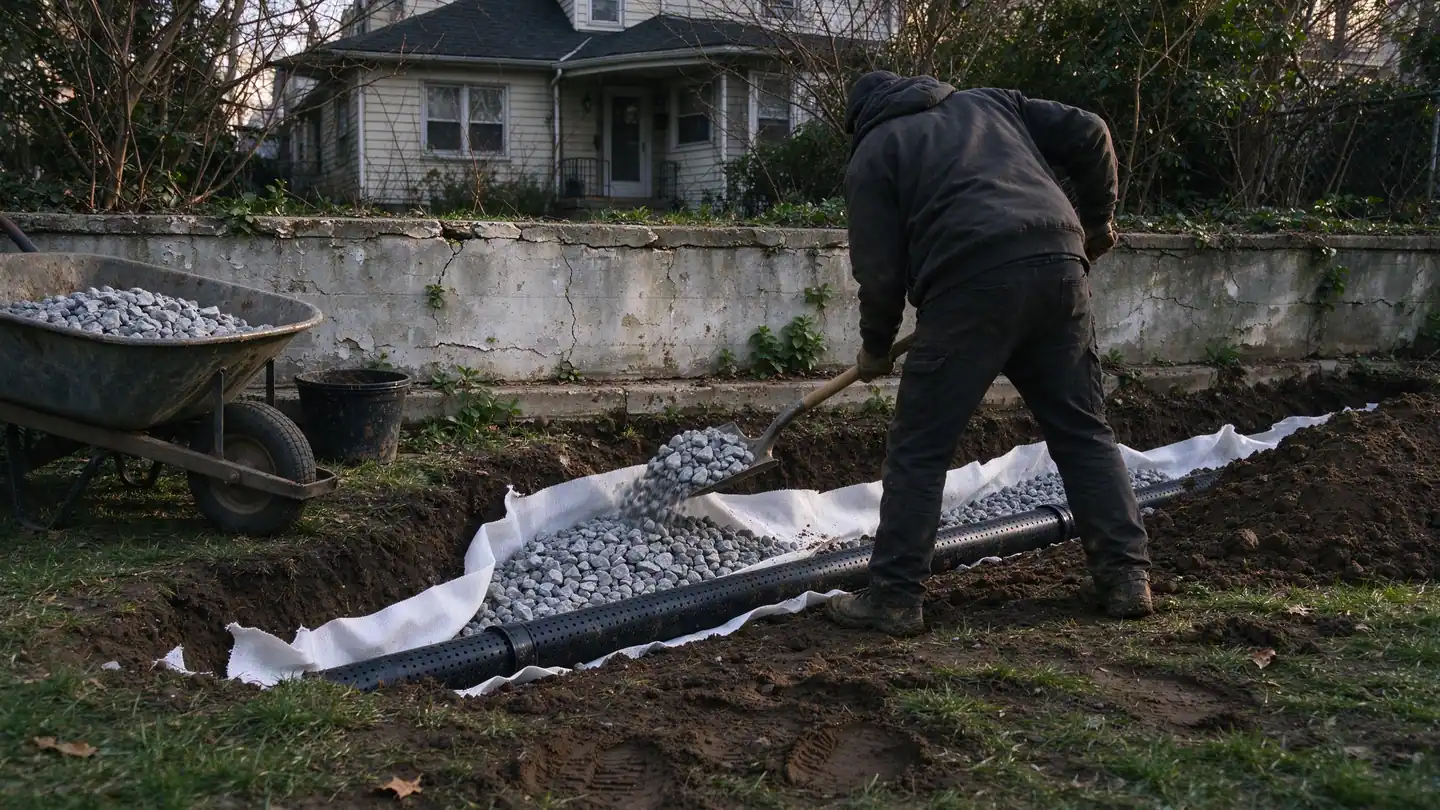
- A drainage zone of clean crushed stone — typically ¾-inch with no fines, at least 12 inches deep directly behind the wall — that lets water fall to the base instead of building up in the soil.
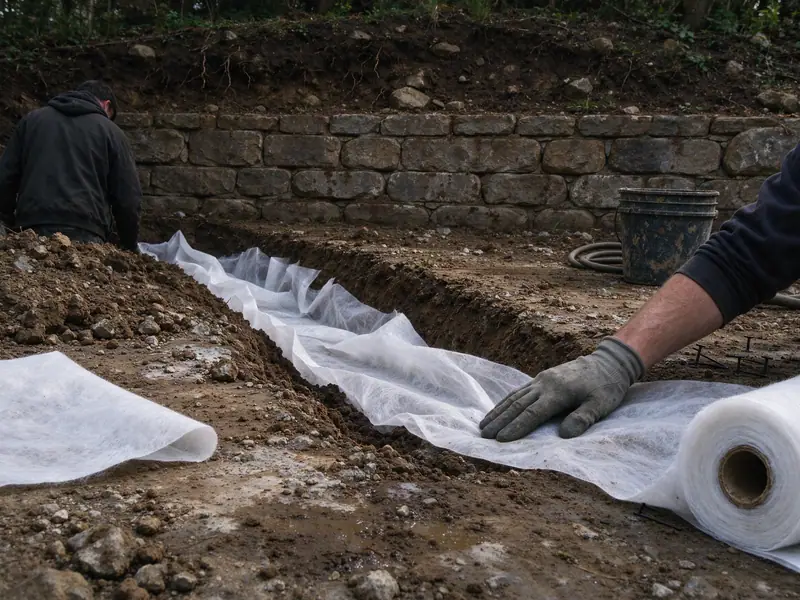
- Filter fabric between that stone and the native soil, so silt doesn't migrate into the stone and clog it over time.
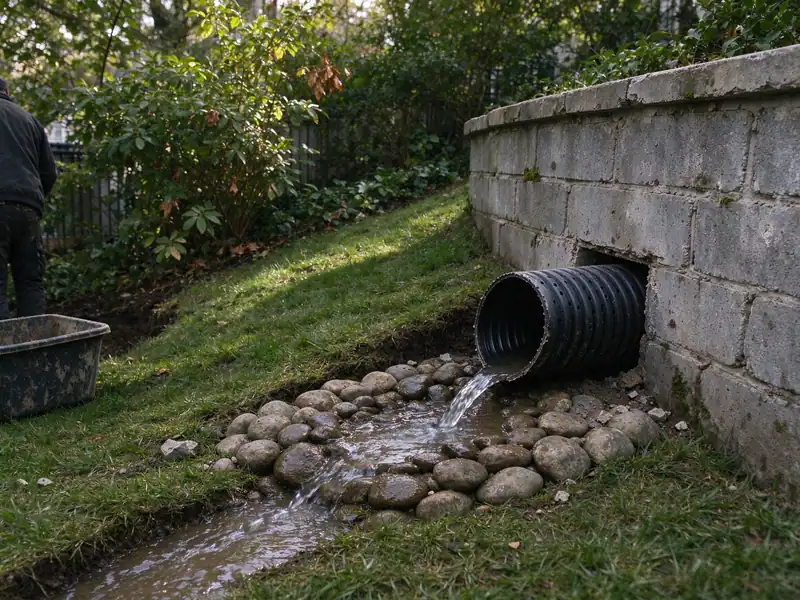
- A perforated pipe at the base of the drainage zone that carries water to the ends of the wall or to an approved outlet. A pipe that doesn't daylight anywhere just fills up.
- Weep holes through the face of concrete and mortared walls, at the base, as a second way out.
Most failed drainage is one of these missing or broken: no stone at all (native soil packed behind the wall), stone without fabric that silted up, a pipe with no outlet, or weep holes that were blocked by soil, roots, mulch or a later layer of paving. The NYC Department of Buildings lists clogged weep holes and water pooling behind a wall among the warning signs owners should act on. Our weep holes guide covers what a working weep hole looks like.
Why NYC walls are getting wetter
Rain here is arriving harder. Hurricane Ida put 3.15 inches in one hour on Central Park on September 1, 2021, and JFK took 8.65 inches in a single day on September 29, 2023 (National Weather Service records). A wall whose drains were marginal in ordinary storms gets overwhelmed in those.
Groundwater is a second factor in parts of southeast Queens, where the water table has risen since the Jamaica Water Supply stopped pumping its wells in 1996 (NYC Mayor's Office), and much of the area was built over filled wetlands and streams (THE CITY, 2024). Walls there can hold back water from below as well as from rain, so a drainage design that only handles surface runoff may not be enough — the outlet has to sit where it can keep discharging when the ground is already wet.
And freeze-thaw turns trapped water into a third problem. Central Park averages about 78 days a year below freezing; water sitting in a wall's joints or in saturated soil behind it expands every time it freezes. Our winter checklist lists what to clear before the cold sets in.
Drainage repairs, from simplest to full retrofit
- Clearing. Rodding and flushing weep holes and pipe outlets, cutting back roots, and lowering soil or mulch that has buried the outlets. Sometimes this is all a wall needs.
- Adding outlets. Coring new weep holes through a concrete or mortared wall at the base, at a spacing that suits the wall, with screens to keep stone in and animals out.
- Surface water control. Redirecting roof leaders and driveway runoff away from the top of the wall, and regrading or adding a swale or drain so water doesn't collect behind it.
- Drainage retrofit. Excavating behind the wall, in sections, down to the footing, then placing filter fabric, a perforated pipe that daylights, and clean crushed stone, and backfilling. This is the lasting fix for a wall built with soil behind it, and on a tall wall or one carrying a surcharge it is done to an engineer's plan, with a DOB permit where required (1 RCNY §101-14).
Drainage work is also a common item on Local Law 37 repair lists; see retaining wall inspection.
What drainage repair costs in NYC
Clearing weep holes and outlets and other minor drainage work usually falls in the minor-repair band of about $325 to $1,600. A full drainage retrofit — excavating behind the wall and installing pipe, fabric and clean stone — typically runs about $90 to $115 per square foot, Fixr's national $70–$90 (January 2025) adjusted by the RSMeans New York City cost index of 129.1. Access matters: excavating behind a rear-yard wall by hand costs more than with a mini-excavator from a driveway.
Compare that with what trapped water does when it isn't fixed: a rebuild runs about $90–$160 per linear foot on the same basis, before engineering. Our repair cost guide has the full breakdown.
Homeowners insurance usually excludes damage from water pressure and earth movement against a retaining wall, so drainage work is generally paid directly. Every job gets a written contract with scope, price and payment schedule before work starts, as New York's General Business Law §771 requires for work over $500.
What's included
- ✓Free site visit with outlet, face and toe inspection
- ✓Water-source trace: roofs, paving, slope, groundwater
- ✓Lean and crack measurements to rule out structural movement
- ✓Line-item price from clearing to full retrofit
- ✓Weep-hole rodding, flushing and new cored outlets
- ✓Perforated pipe that daylights to an approved outlet
- ✓Clean ¾-in stone wrapped in filter fabric
- ✓Closeout photos, including the buried layers
DIY vs. cheap operator vs. a wall built properly
| Factor | DIY | Cheap operator | Built properly |
|---|---|---|---|
| Drainage behind the wall | Native soil backfill | A little gravel, no pipe | 12 in+ of clean crushed stone, filter fabric, perforated pipe that daylights |
| Footing | Set on topsoil or sod | Shallow, uncompacted | Compacted base, sized and set below the frost line to the design |
| Reinforcement | None | None | Geogrid or rebar to an engineer's design where height and load call for it |
| Permit and engineer (walls 4 ft+ or surcharged) | Skipped | Skipped or "not needed" | Stamped plans and a DOB filing |
| Local Law 37 (10 ft+ on a right-of-way) | Unknown | Ignored | Built and documented so the QRWI report goes smoothly |
| Paperwork you keep | None | A handwritten estimate | Written contract, line-item scope, closeout photos |
| Where it usually fails | First freeze-thaw seasons | Within a few years, at the drainage | Designed to carry its load for decades |