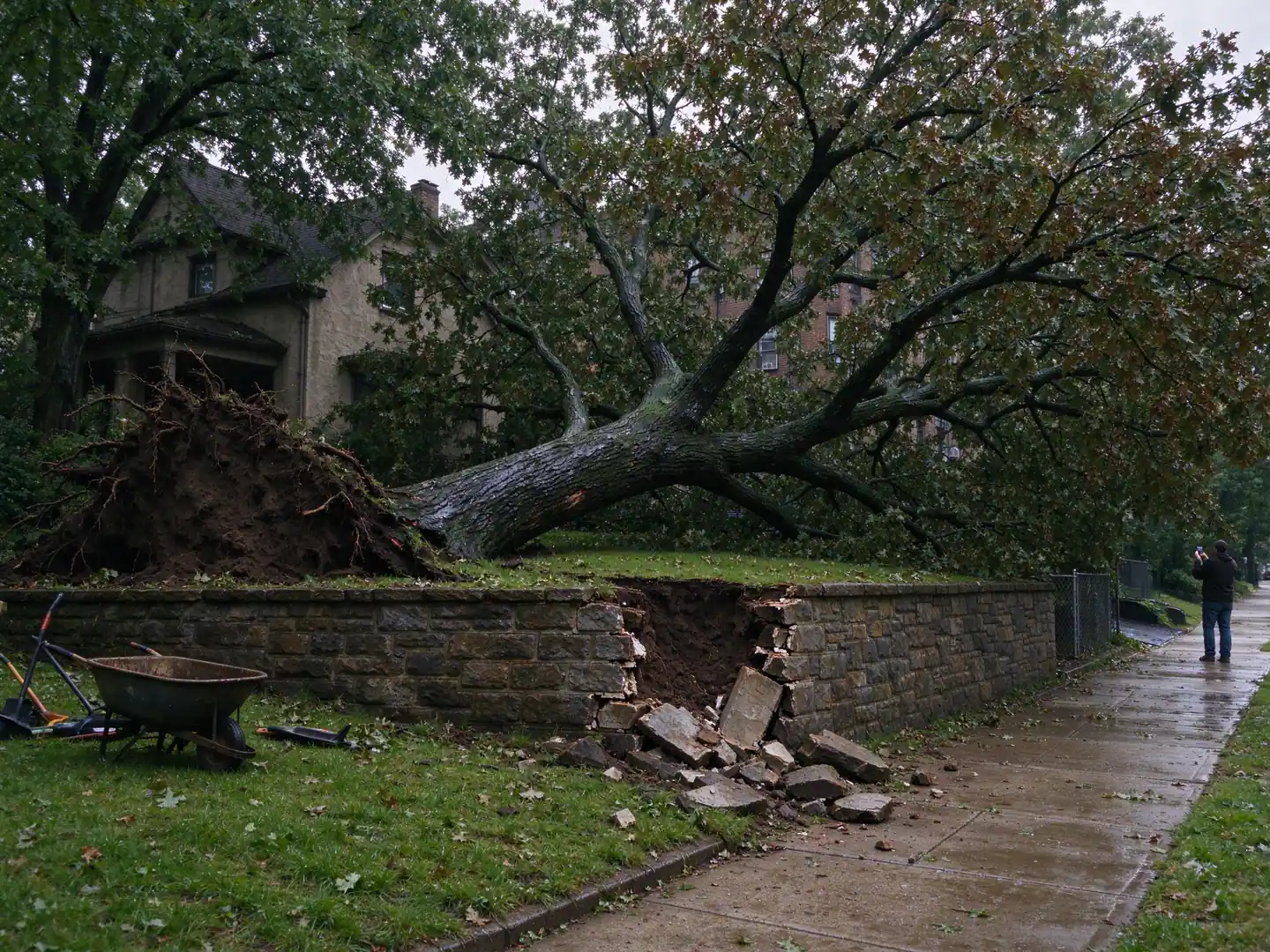
Usually not. Standard HO-3 homeowners policies exclude earth movement, water pressure against retaining walls and wear and tear, which cause most collapses. A sudden covered event, like a car striking the wall or a tree falling on it, may be covered under Other Structures (Coverage B), often limited to about 10% of dwelling coverage. Read your own policy.
- Standard policies exclude earth movement, water pressure on retaining walls and wear and tear — the usual causes of collapse (MPIUA; MoneyGeek).
- Sudden covered perils, such as a vehicle or falling tree, may be covered under Other Structures (Coverage B).
- Coverage B is typically about 10% of the dwelling limit, and payouts may be at actual cash value (MoneyGeek).
- Damage the collapse causes to the house itself may be covered as ensuing loss, depending on the policy.
NYC Retaining Walls is a licensed and insured retaining wall contractor that rebuilds failed walls and writes the scope an adjuster needs to see. So, does homeowners insurance cover retaining wall collapse? In most cases, no — and it helps to know why before you file. A standard HO-3 policy treats a retaining wall as an “other structure,” but its exclusions for earth movement, water pressure and wear and tear cover the reasons most walls fail. We aren’t insurance advisers; this guide explains the usual policy structure so you know what to ask. Our retaining wall replacement page covers the rebuild itself.
What usually is and isn’t covered?
| Cause of the collapse | Usually covered? | Why |
|---|---|---|
| Soil movement, settling, sliding | No | Earth-movement exclusion |
| Water pressure behind the wall after rain | No | Exclusion for water pressure on retaining walls |
| Age, rot, cracked mortar, failed drainage | No | Wear, tear and maintenance exclusion |
| A car or truck hits the wall | Often yes | Sudden covered peril, under Coverage B |
| A tree falls on the wall | Often yes | Sudden covered peril, under Coverage B |
| The collapse damages your house | Possibly | Ensuing damage may be covered |
These are general patterns from standard forms, summarized from MoneyGeek, the MPIUA earth-movement exclusion and PropertyCasualty360. Your policy, endorsements and state rules decide your claim — read your own policy, or ask your agent to show you the clause.
How much would Other Structures pay?
If the cause is covered, a retaining wall typically falls under Coverage B, Other Structures, which is commonly set at about 10% of the dwelling limit (MoneyGeek). On a policy with $600,000 of dwelling coverage, that’s about $60,000 for every detached structure combined — fences, garages, sheds and walls. Some policies pay actual cash value, meaning depreciated value, rather than replacement cost, which matters for an old wall. The deductible applies.
For scale, retaining wall replacement in NYC typically runs about $90–$160 per linear foot to rebuild (Fixr national $70–$125 × RSMeans NYC index 129.1); the replacement cost guide has worked examples.
What should you do after a wall collapses?
- Make it safe. Keep people away; if the collapse threatens a building, a sidewalk or a street, call 311, and 911 if anyone is hurt. The collapse guide covers the first 24 hours.
- Document everything. Wide and close photos and video of the wall, the soil, any vehicle or tree involved, and damage to the house or the neighbor’s property, with dates.
- Notify your carrier promptly, even if you expect a denial. Late notice can be its own reason for refusal.
- Prevent further damage. Reasonable steps — tarping exposed soil, diverting water — are usually expected. Keep receipts.
- Get a written cause and scope. An engineer’s letter or a contractor’s written assessment that describes what failed and why helps the adjuster and you.
What paperwork helps an adjuster?
A clear account of cause. Adjusters decide coverage by what made the wall fail, so the most useful document is a written assessment that describes the wall (length, height, material), the failure (rotation, sliding, a vehicle strike, a fallen tree) and the evidence for it, with photos. Add a line-item price for the repair or rebuild. For walls 4 feet or taller, an engineer’s letter carries more weight. Our retaining wall repair page explains what a site visit records, and the cost estimator gives a starting figure for your own planning.
What if the collapse damaged your neighbor’s property?
That’s a liability question, separate from your own wall. The liability section of a homeowners policy may respond if the neighbor alleges negligence, but insurers contest these claims; Insurance Business reported one carrier winning a coverage fight after a half-built wall flooded a neighboring home. On a lot-line wall, ownership is joint under Admin Code §28-305.1.1, which affects who is responsible in the first place — see the neighbors guide and shared retaining wall repair.
Can you make a wall less likely to fail uncovered?
Yes: keep water out of the soil behind it. Since the exclusions cover the slow failures, maintenance is effectively the only protection. Clear weep holes, keep downspouts away from the top of the wall, and fix drainage before cracks spread; see retaining wall drainage repair and the weep holes guide. If the wall is already cracking or leaning, a repair at about $325–$1,600 for minor work costs far less than an uncovered rebuild; the wall assessment helps you judge urgency.
Assume a wall that failed from soil and water won't be covered, check your policy for a sudden-event exception, and get a written scope that explains the cause before the adjuster visits. For that written scope and price, (718) 555-0100.
Frequently asked questions.
Will insurance cover damage my collapsed wall does to my neighbor's property?
Possibly, under the liability section of your policy, if the neighbor claims you were negligent — for example, by ignoring obvious signs of failure. Insurers often contest these claims, and coverage depends on the policy language and the facts. Notify your carrier promptly, don't admit fault on the spot, and consider talking to an attorney if the damage is significant.
Does insurance pay if a retaining wall fails after heavy rain?
Rarely. Damage from water pressure behind a retaining wall, and from soil movement caused by saturated ground, is typically excluded under standard homeowners policies. Storms like Hurricane Ida, which dropped 3.15 inches of rain on Central Park in one hour in 2021, are exactly when those exclusions apply. Some policies or endorsements differ, so read yours and ask your agent.
Does a policy cover a retaining wall that holds up my house?
Sometimes the answer differs. The water-pressure exclusion in many standard forms is written for retaining walls that don't support a building, and walls that are part of the dwelling's structure may be treated differently. The earth-movement exclusion can still apply. This is a policy-language question, so ask your carrier or agent to point to the clause that applies.