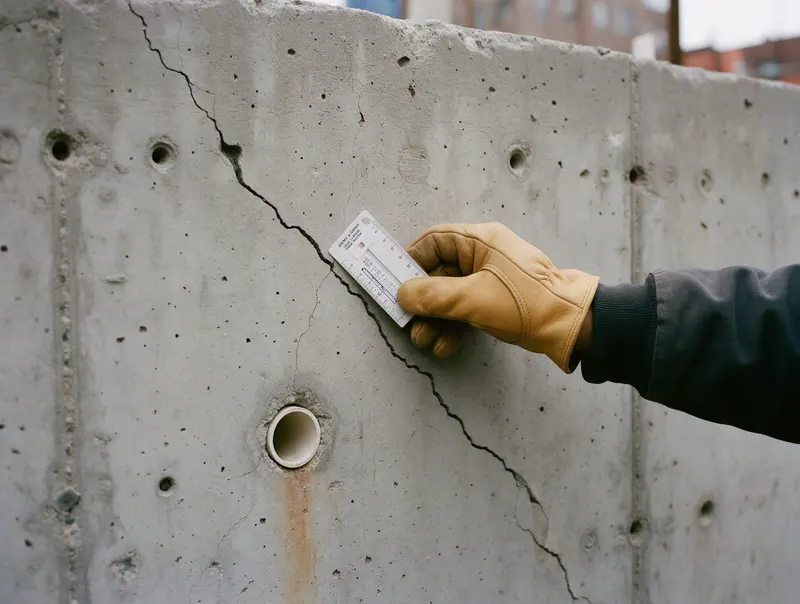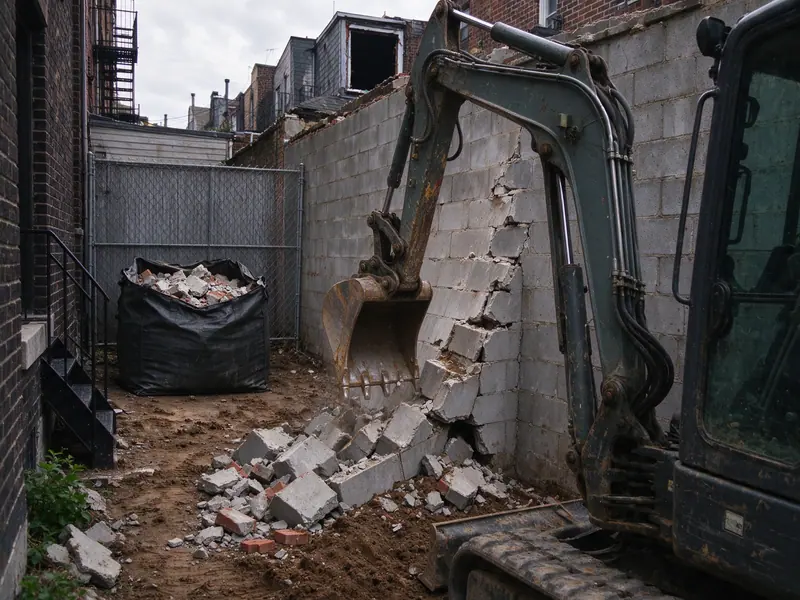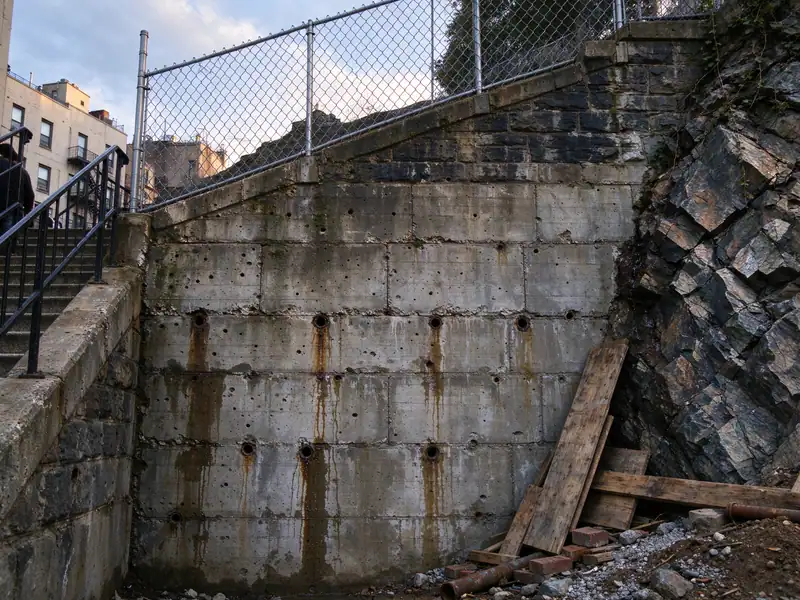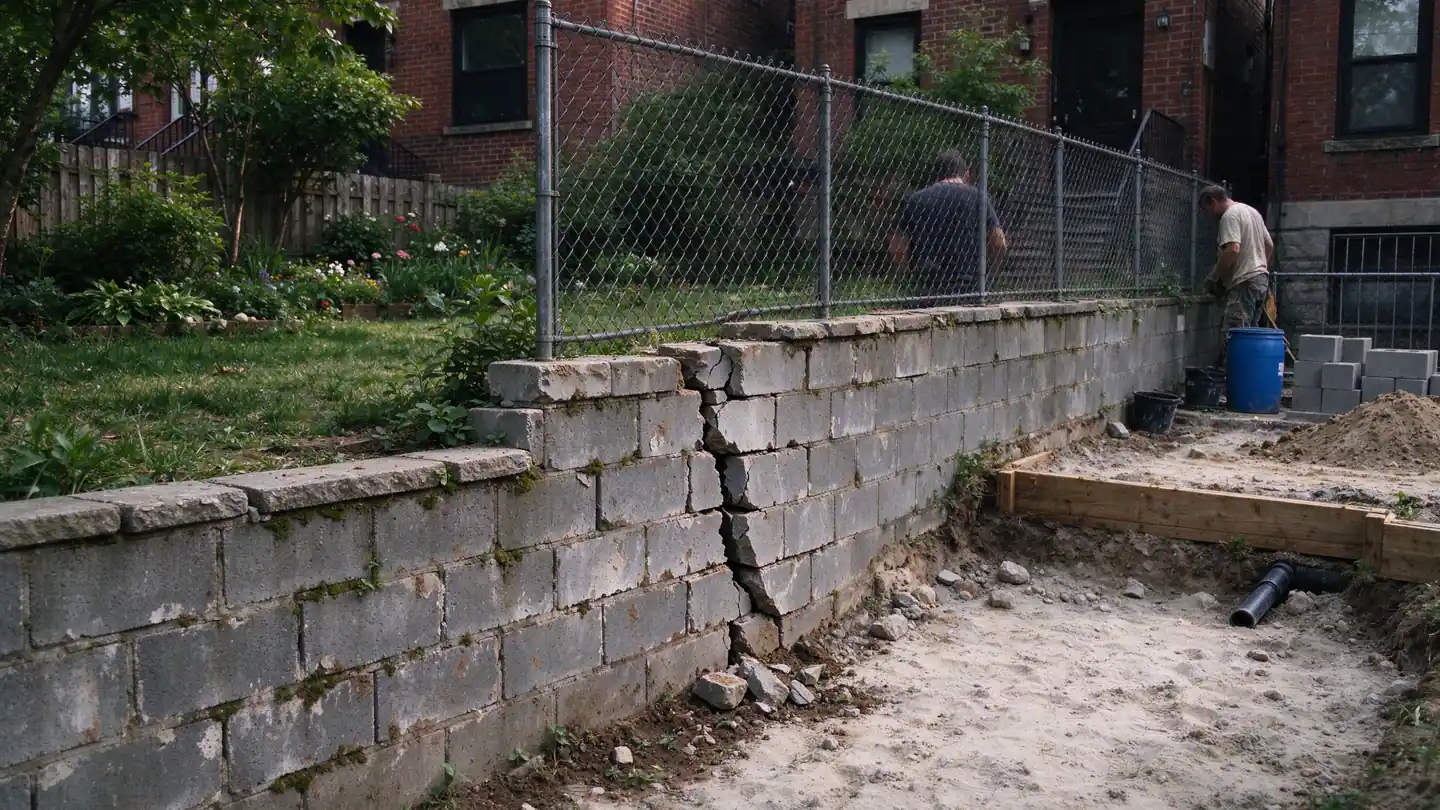
NYC Retaining Walls is a licensed and insured retaining wall contractor that handles shared retaining wall repair for neighbors across the five boroughs — lot-line walls between two houses, walls behind a row of attached homes, and long walls that cross several lots. Shared retaining wall repair is half engineering and half paperwork. NYC law is clear about the basic split: a retaining wall on the common lot line, partly on both lots, is the joint responsibility of both owners, each paying half unless they agree otherwise (Admin Code §28-305.1.1). What makes these jobs stall is everything around that rule: nobody is sure where the line is, one owner wants a patch and the other a rebuild, or the contractor can't get into one of the yards.
What we do on the first visit
The first visit is free and works best with both owners there, or at least both informed:
- We measure the whole wall, not just one side — length, height at several points, lean and cracks — and note which lot each problem area sits on.
- We ask for the survey. Only a New York State–licensed land surveyor can settle where the wall sits relative to the lot line; DOB doesn't keep owners' surveys. If there isn't a recent one, we tell you so before anyone argues about shares.
- We check DOB records for both properties: violations, complaints, permits and the Local Law 37 flag.
- We plan access from each yard — where equipment, materials and debris can go, and what has to be protected.
- You both get the same written scope and price, with the cost split shown as line items per owner, usually within two business days.
Who pays for what on a lot-line wall
NYC's Administrative Code sets the defaults:
- On the lot line (partly on both lots): joint responsibility, half the cost each, unless the owners agree otherwise (§28-305.1.1). Per DOB's FAQ, being on the high side or the low side makes no difference — only the wall's location relative to the line counts.
- Wholly on one lot: that owner's responsibility, and the neighbor must allow access for repairs (§28-305.1.2).
- One owner changed the grade: that owner builds and maintains the wall at their own cost, entirely on their own land (§28-305.2). You can't backfill against a neighbor's wall.
- Private agreements between owners are allowed (§28-305.3), and an owner who removes a shared wall must protect the neighbor and replace it at their own cost.
Walls crossing several lots get more complicated. Courts have apportioned repair cost among the lots touching the damaged section (230-79 Equity v. Mancuso, 2d Dept 2012), and in 2011 DOB declared a roughly 10-foot wall shared by 11 Inwood buildings unsafe, saying everyone abutting it was responsible. For the legal question in depth, read who is responsible for a retaining wall between neighbors.
How we run a joint repair
One scope, one price, two shares. Both owners see the same measured scope. The written price shows the total and each owner's share — 50/50, by lot frontage, or whatever split you've agreed — with a written contract signed by both, as New York's General Business Law §771 requires for home improvement work over $500.
Access in writing. We list what each yard will see: equipment path, staging area, protection of plantings and paving, work hours and restoration.
Shared inspection paperwork. If the wall is under Local Law 37, one QRWI can cover the whole wall, but each owner pays DOB's filing fees; see retaining wall inspection.
When a neighbor won't cooperate. §28-305.1.2 requires access for repairs to a wall wholly on one lot, and New York's RPAPL §881 lets a court grant temporary access for repairs. §881 was amended in December 2025, so talk to a lawyer before relying on it; our access guide covers the basics. If a shared wall is actively failing, a call to 311 starts a DOB inspection. For repair methods, see retaining wall repair and retaining wall replacement.
What a shared wall repair costs
Pricing is the same as for any wall, then split. On national cost guides adjusted by the RSMeans NYC index of 129.1, minor repairs typically run about $325–$1,600, anchoring about $75–$105 per linear foot and a rebuild about $90–$160 per linear foot (Fixr, January 2025), before engineering and permits. A survey, if you don't have one, is a separate cost from a licensed surveyor.
What's included
- ✓Free site visit measuring the whole wall, both sides
- ✓Problem areas mapped to each lot
- ✓DOB records check for both properties
- ✓One written scope and price for both owners
- ✓Cost split shown as line items per owner
- ✓Written access plan for each yard
- ✓Contract signed by both owners
- ✓Closeout photos for both owners and any QRWI
DIY vs. cheap operator vs. a wall built properly
| Factor | DIY | Cheap operator | Built properly |
|---|---|---|---|
| Drainage behind the wall | Native soil backfill | A little gravel, no pipe | 12 in+ of clean crushed stone, filter fabric, perforated pipe that daylights |
| Footing | Set on topsoil or sod | Shallow, uncompacted | Compacted base, sized and set below the frost line to the design |
| Reinforcement | None | None | Geogrid or rebar to an engineer's design where height and load call for it |
| Permit and engineer (walls 4 ft+ or surcharged) | Skipped | Skipped or "not needed" | Stamped plans and a DOB filing |
| Local Law 37 (10 ft+ on a right-of-way) | Unknown | Ignored | Built and documented so the QRWI report goes smoothly |
| Paperwork you keep | None | A handwritten estimate | Written contract, line-item scope, closeout photos |
| Where it usually fails | First freeze-thaw seasons | Within a few years, at the drainage | Designed to carry its load for decades |