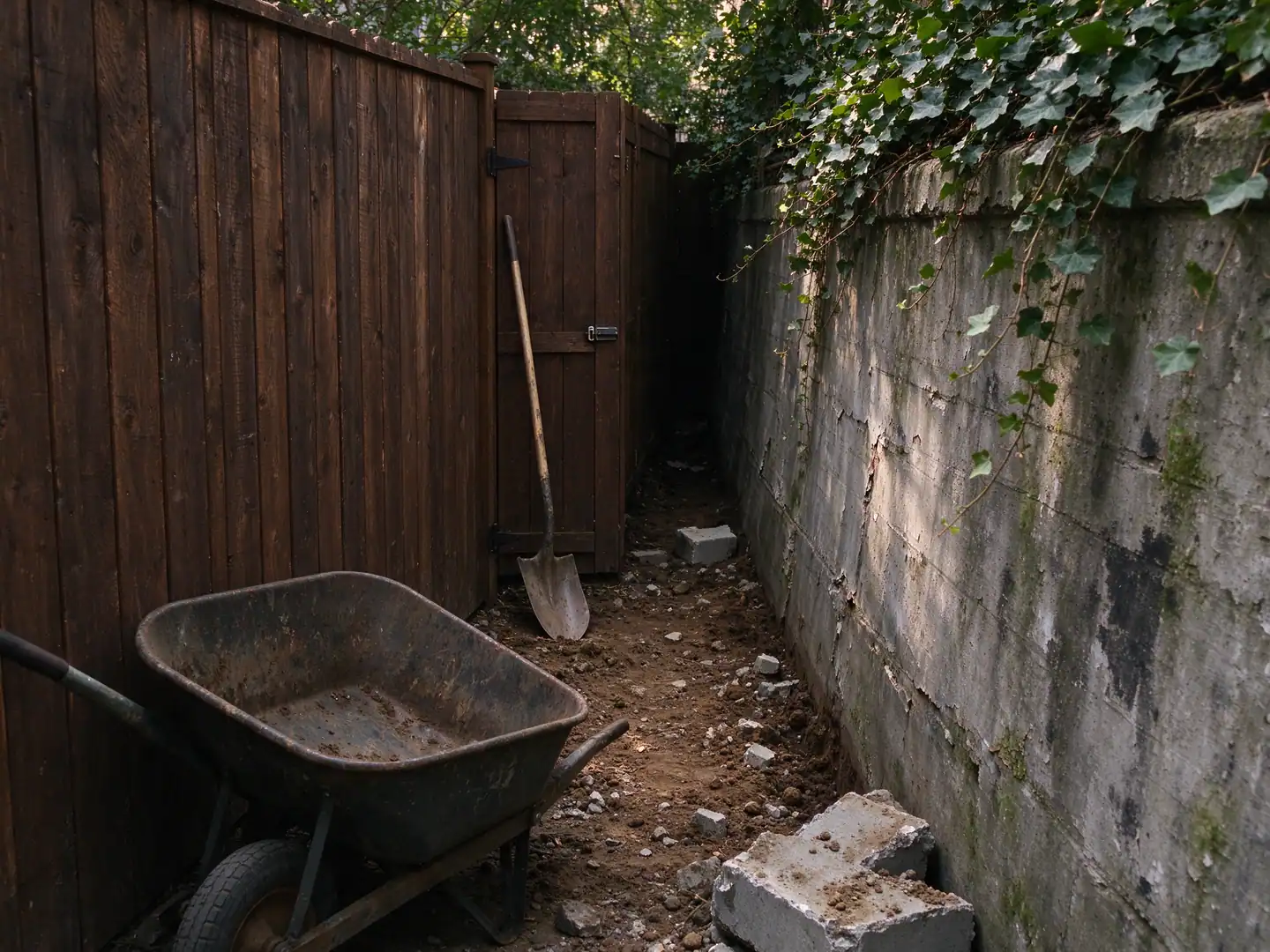
If your neighbor won't allow access for retaining wall repair, start with the Admin Code: §28-305.1.2 says the neighbor of a wall wholly on one lot must permit access for repairs. Put a specific written request on the table. If they still refuse, RPAPL §881 lets a court grant temporary access — talk to an attorney.
- A wall wholly on one lot is that owner's, and the neighbor must permit access for repair (Admin Code §28-305.1.2).
- NY RPAPL §881 lets a court grant a license to enter a neighbor's land for repairs; it was amended in December 2025.
- Spence v. Strauss Park Realty (1st Dept 2022) involved access to repair a deteriorated lot-line retaining wall.
- Courts commonly attach conditions: insurance, indemnity, repair of any damage and sometimes a license fee.
NYC Retaining Walls is a licensed and insured retaining wall contractor that repairs walls on tight city lots, where the work often can’t be done from one side. When a neighbor won’t allow access for retaining wall repair, you have a stronger position in New York City than most owners realize: the Administrative Code makes access a duty, and state law gives the courts a way to enforce it. This guide covers the steps in order. Our shared retaining wall repair page explains how joint and lot-line jobs are run.
Does my neighbor have to let my contractor in?
Under NYC Admin Code §28-305.1.2, a retaining wall that sits wholly on one lot is that owner’s responsibility — and the adjoining owner must permit access for its repair. If the wall straddles the lot line, it’s a joint wall under §28-305.1.1 and both owners share the work and the cost, which usually settles the access question. Either way, start by confirming where the wall sits with a licensed surveyor’s survey; the neighbors guide explains why.
How do you ask so the answer is yes?
Most refusals are about uncertainty: how long, how much mess, who pays if something breaks. A specific written request answers those before they’re asked.
- What and why. A short description of the repair and the reason, ideally with the engineer’s or contractor’s scope attached.
- Where and how long. A sketch of the work area on their side, the number of days, and working hours.
- Protection. How their plantings, fence, paving and foundation will be protected, and a promise to restore anything disturbed.
- Insurance. A certificate of liability insurance naming them as additional insured.
- A short access agreement both of you sign, with the dates and terms above.
A free site visit gets you a written scope you can attach.
Can the job be done from your side?
Sometimes, and it’s worth asking before any dispute escalates. Repointing and face repairs on your side of a wall need no access. Some stabilization work, such as anchors drilled through the wall face, is done from the face side, which on a wall that faces your yard is your side. A rebuild usually isn’t: excavating behind a wall to install ¾-inch clean stone, filter fabric and a perforated drain means working on the retained side. Ask the engineer which approach the wall actually needs; leaning retaining wall repair and retaining wall drainage repair describe the methods.
What if they still say no?
New York’s RPAPL §881 lets an owner who needs to enter a neighbor’s land to make repairs petition a court for a temporary license when the neighbor refuses. Spence v. Strauss Park Realty (1st Dept 2022) involved exactly this — access to repair a deteriorated retaining wall on a lot line. Courts have commonly granted access with conditions: insurance, indemnity, repair of any damage, and sometimes a license fee for the use of the neighbor’s land.
§881 was substantially amended in December 2025. We don’t summarize the new text here; talk to a real-estate attorney about how it applies before you file, and keep copies of every written request you’ve made — they show the court you asked reasonably.
What if the wall is getting worse while you wait?
Don’t let a dispute become a collapse. DOB lists leaning, cracks or holes in the soil at the top, swelling at the base, bulging and water pooling behind the wall as warning signs. If the wall could fall onto a sidewalk, a yard or a building, call 311; DOB can inspect and issue orders to the responsible owners. If anyone is in danger, call 911. The collapse guide covers the first steps, and the wall assessment helps you judge urgency.
What does the repair cost once you’re in?
That depends on the wall, not the dispute. In NYC, minor repairs typically run about $325–$1,600, anchoring a leaning section about $75–$105 per linear foot, and rebuilding about $90–$160 per linear foot (Fixr national figures × RSMeans NYC index 129.1). On a lot-line wall the default split is 50/50 under §28-305.1.1. The cost estimator gives a starting number you can share with your neighbor.
Most access disputes end with a specific written plan, an insurance certificate and a short agreement; a court petition is the backstop, not the first move. For a written repair plan you can hand your neighbor, (718) 555-0100.
Frequently asked questions.
Can I just go onto my neighbor's property to fix my wall?
Not without permission or a court order. The Admin Code's access duty (§28-305.1.2) gives you a strong position, but entering without consent invites a trespass dispute and can stall the job. Ask in writing, offer insurance and restoration, and if you're refused, have an attorney seek a license under RPAPL §881, which was amended in December 2025.
What will a court require if it grants access?
Under RPAPL §881, New York courts have commonly granted access with conditions protecting the neighbor: proof of liability insurance naming them, an agreement to repair any damage, a defined time period and work area, and in some cases a license fee for the use of their land. Because the statute was amended in December 2025, ask an attorney how the current version applies to your situation.
What if the wall is unsafe and my neighbor still won't cooperate?
Safety comes first. If the wall is cracking badly, bulging or could fall onto a sidewalk, a yard or a building, call 311 so DOB can inspect; if anyone is in danger, call 911. DOB can issue orders to the responsible owners. Keep the area below the wall clear, document the condition with dated photos, and keep pursuing access in writing.