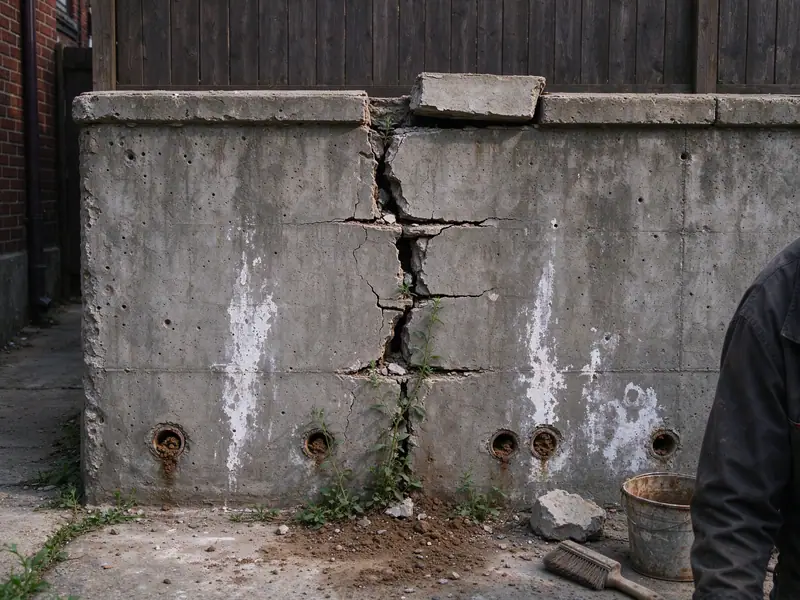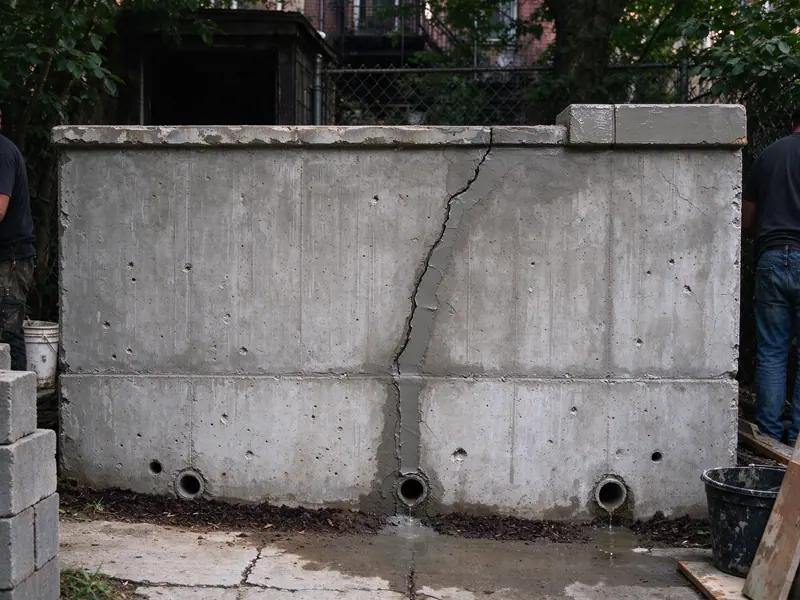
NYC Retaining Walls is a licensed and insured retaining wall contractor that handles retaining wall repair in NYC, across all five boroughs. Most retaining walls that need repair are not falling down — they're telling you something: a crack that opened over the winter, a section that leans a little further each spring, water running out of the face instead of the weep holes. Retaining wall repair done properly starts with the cause. A wall that cracked because water is trapped behind it will crack again after a patch, because a saturated 6-foot wall carries roughly 1,100 pounds of water pressure per linear foot on top of the soil load (basic hydrostatics: ½ × 62.4 lb/ft³ × (6 ft)²).
What we do on the first visit
The first visit is free and takes about 45 minutes. Here is exactly what happens:
- We measure the wall — length, exposed height at its tallest point, and lean (with a level and plumb line at three or more stations), so you have numbers, not impressions.
- We map the cracks. Crack width is read with a crack card. For reference, ACI 224R lists about 0.012 in (0.3 mm) as a reasonable crack width for concrete exposed to soil and moisture; wider cracks, stepped cracks in block, and cracks that are offset (one side sticking out past the other) point to movement, not shrinkage.
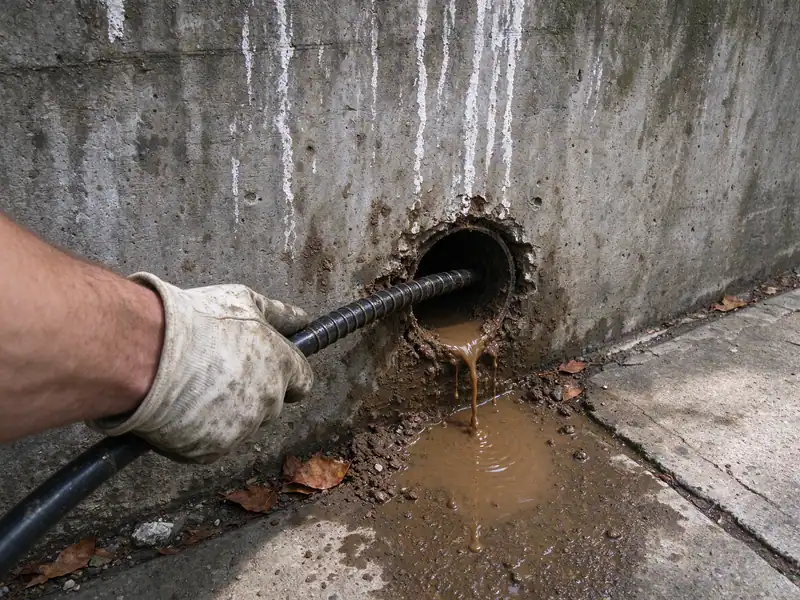
- We check the drainage — weep holes, the outlet of any perforated pipe, wet staining, efflorescence and soil washing out at the toe.
- We look up the property on the DOB Building Information System for open violations, complaints and the retaining-wall flag that marks walls covered by Local Law 37.
- You get a written scope and price — repair, stabilize or rebuild, with line items — usually within two business days.
Why NYC retaining walls fail
Three forces do most of the damage here.
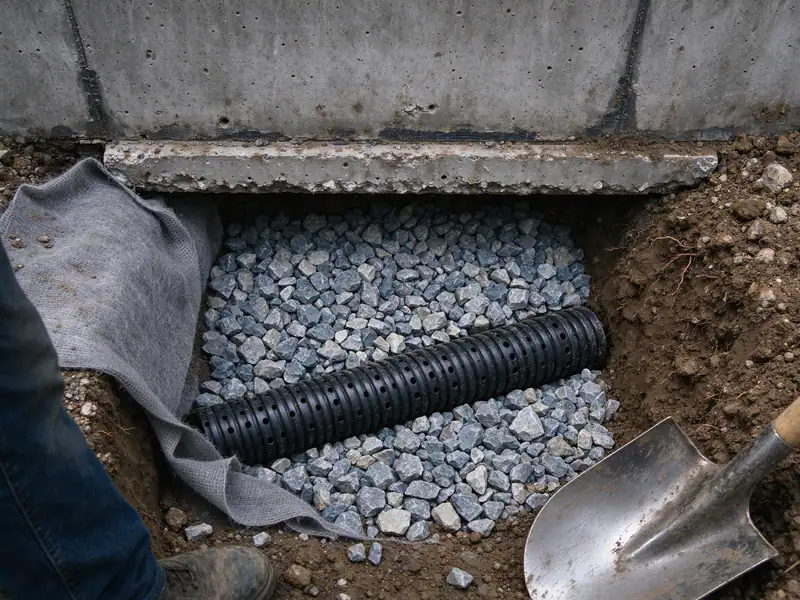
Water. The most common failure point is drainage: no clean crushed stone behind the wall, no perforated pipe at the footing, weep holes that clogged years ago. Soil that can't drain gets heavier and pushes harder. NYC's rain is getting more intense: Hurricane Ida put 3.15 inches in one hour on Central Park on September 1, 2021, and JFK took 8.65 inches in a single day on September 29, 2023 (National Weather Service records).
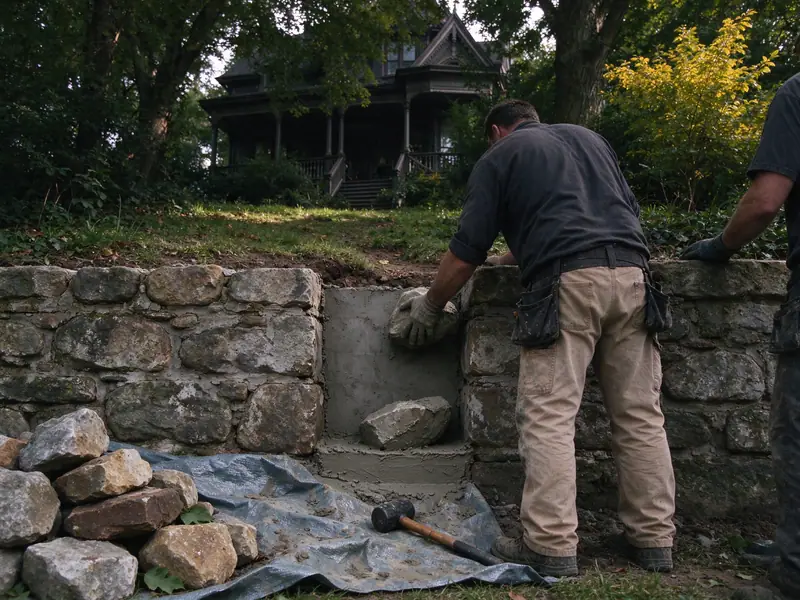
Freeze-thaw. Central Park averages about 78 days a year below freezing, and most of those are thaw-again days. Every cycle pries at mortar joints, open cracks and the back of the wall where water sits. Old mortared stone walls — common in Bay Ridge, Riverdale and on Grymes Hill — show it as loose stones and hollow-sounding joints.
Load the wall was never designed for. A driveway, a parked car, a shed, a new patio or a neighbor's regrading along the top of a wall adds what engineers call surcharge. Under NYC rules (1 RCNY §101-14), a wall carrying a surcharge needs a DOB permit at any height — which tells you how seriously the code treats that extra load.
Repair, stabilize or rebuild: how we decide
We recommend the smallest job that actually stops the movement.
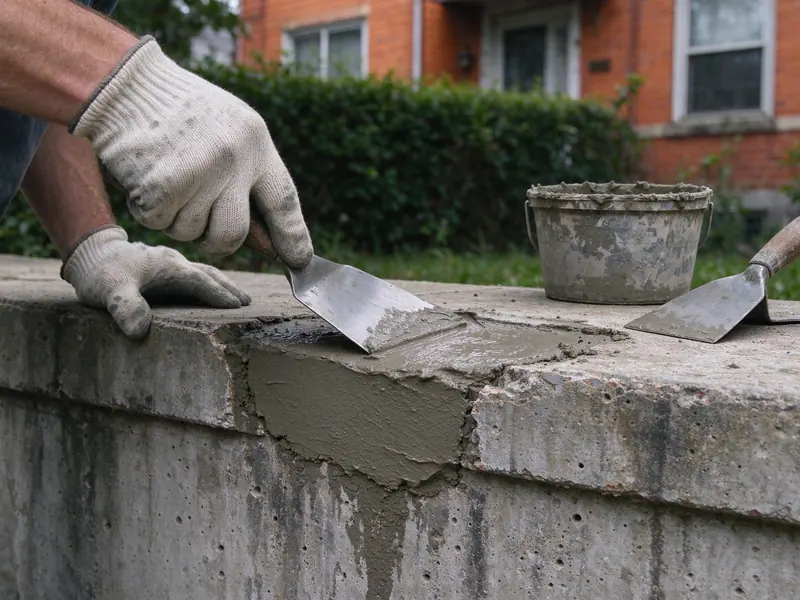
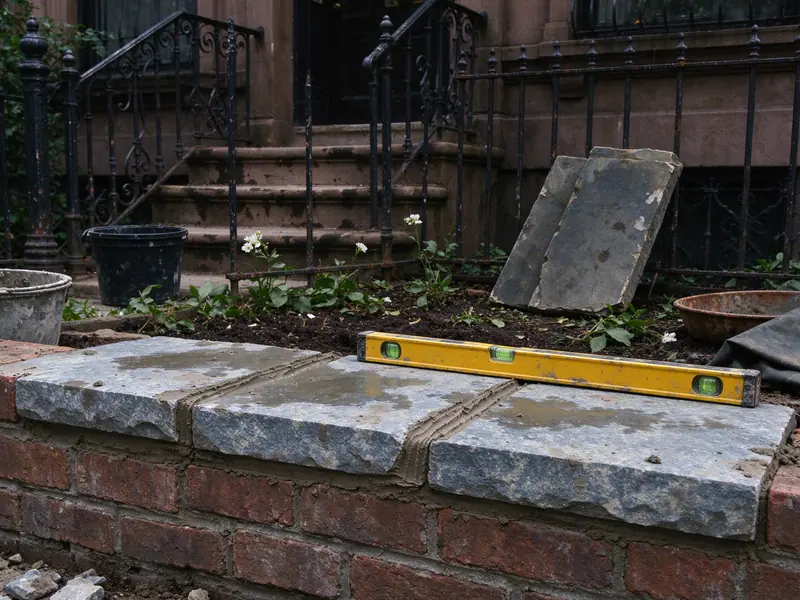
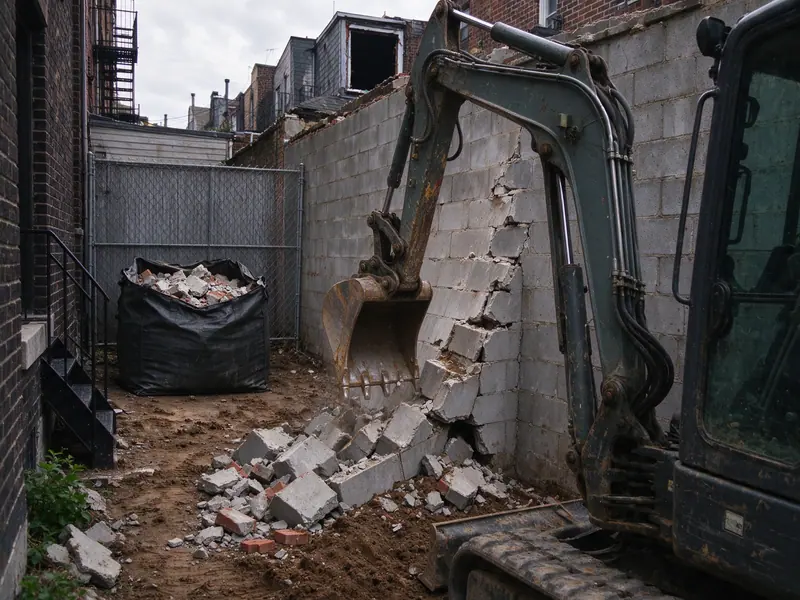
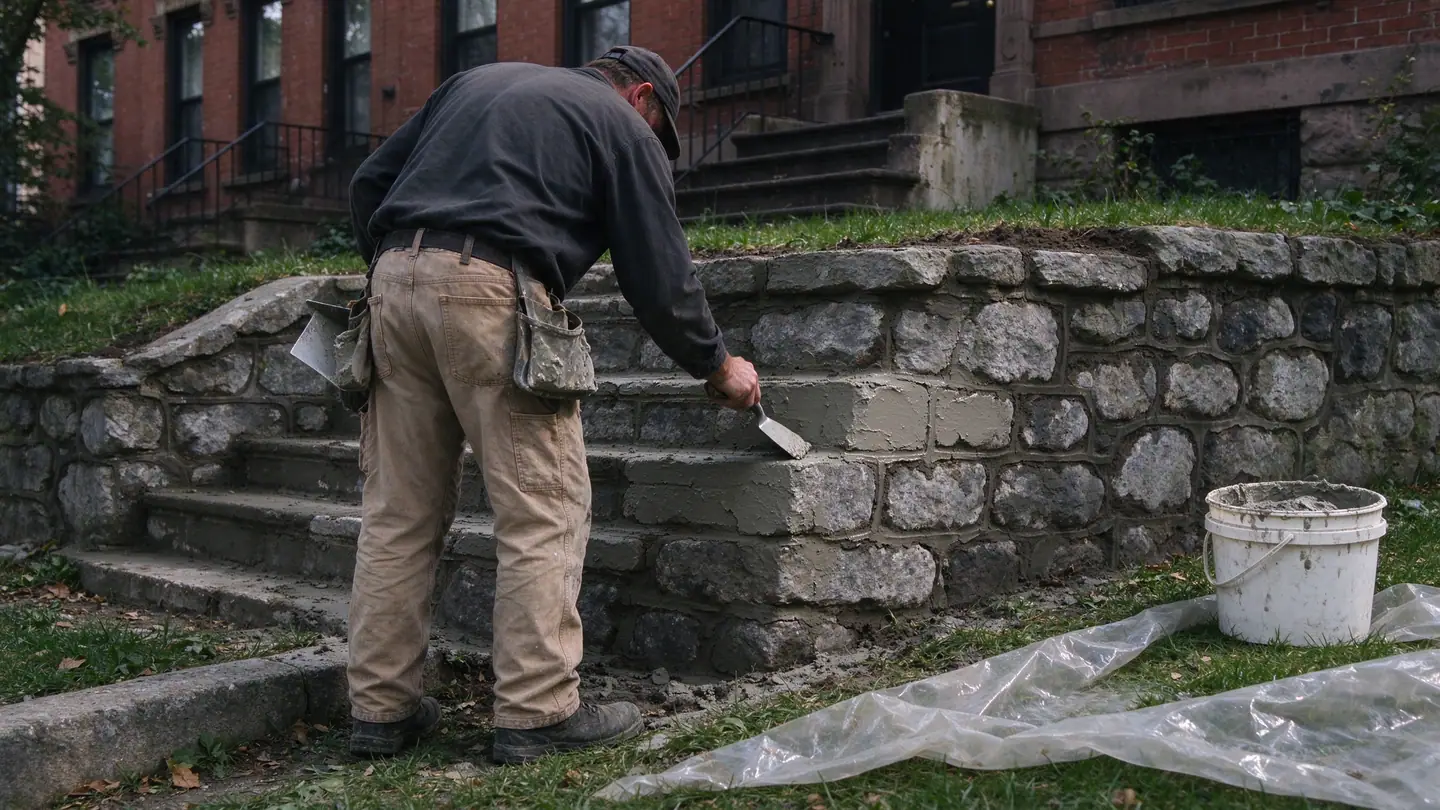
- Repair — repointing mortar joints, resetting loose stone or block, patching spalled concrete, replacing caps, clearing or adding weep holes. Right for walls that are plumb and stable, with damage at the surface.
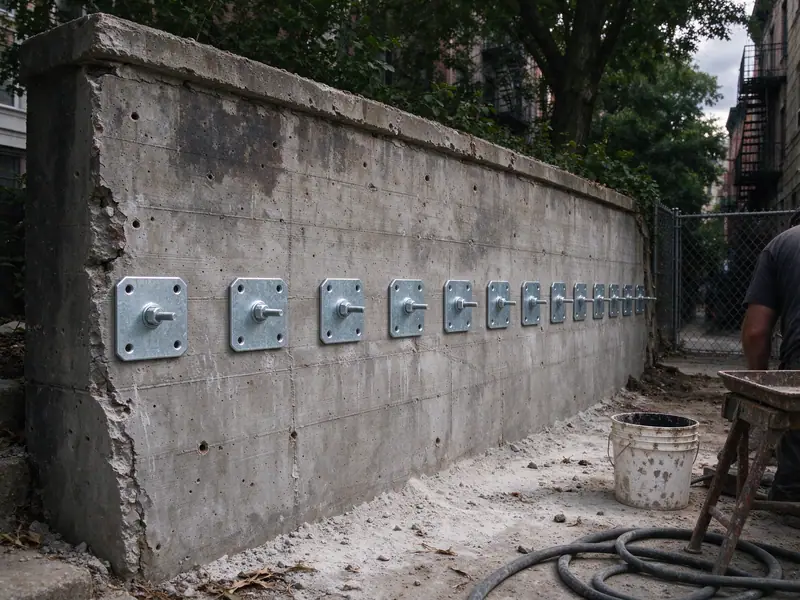
- Stabilize — when a wall leans or bulges but the body of the wall is sound, anchors can hold it in place: helical anchors or tiebacks drilled through the wall into stable soil behind it, with a bearing plate on the face. This usually costs far less than demolition and keeps the yard intact. See leaning retaining wall repair.
- Rebuild — when the wall is rotating at the footing, has lost large sections, or is built of material that has reached the end of its life (timber and railroad ties especially). See retaining wall replacement.
If the numbers are close, we'll show you both options on the same page so you can compare. Our repair vs. replacement guide walks through the same decision with costs.
Permits, engineers and Local Law 37
Most surface repairs — repointing, resetting a few stones, replacing a cap — don't need a filing. Structural work is different. A retaining wall 4 feet or taller (measured from the top of the footing), or any wall holding a surcharge, needs a DOB permit with plans filed by a licensed engineer or architect (1 RCNY §101-14). We work to stamped engineering plans on that work and coordinate the filing; we don't guess at structural repairs.
If your wall is 10 feet or taller at any point and fronts a sidewalk, street, alley or other public right-of-way, it falls under Local Law 37 of 2008 (NYC Admin Code §28-305.4). A Qualified Retaining Wall Inspector — a New York–licensed professional engineer — has to inspect it every five years. If the report rates the wall Safe with Repairs and/or Engineering Monitoring (SREM) or Unsafe, the repairs are required, and an Unsafe condition has to be corrected within 90 days. We repair to the inspector's report and can connect you with an independent inspector if you don't have one. Details: retaining wall violation repair and the Local Law 37 guide.
Insurance, pricing and paying for the repair
Standard homeowners policies usually exclude damage from earth movement, water pressure and gradual deterioration — which covers most retaining wall failures. Sudden events are different: a car hitting the wall or a tree coming down on it may be covered under the policy's Other Structures section, which on a standard HO-3 is typically 10% of the dwelling limit. Read the exclusions page of your own policy and call your agent before you assume either way; our insurance guide explains the usual language.
On price, minor repairs in NYC typically run about $325 to $1,600, anchoring runs about $75 to $105 per linear foot, and a rebuild runs about $90 to $160 per linear foot, before engineering and permit fees. Those bands are national cost-guide figures (Fixr, January 2025) adjusted by the RSMeans New York City cost index of 129.1. Access matters more here than almost anywhere: a rear-yard wall in a rowhouse block, where every bag of mortar is hand-carried through the house or down an alley, costs more than a front wall at the curb. Our repair cost guide breaks it down, and the cost estimator gives you a number in under a minute.
Every job gets a written contract with the scope, price and payment schedule before work starts — New York's home improvement law (General Business Law §771) requires one for jobs over $500.
What's included
- ✓Free site visit with measured height, length and lean
- ✓Crack map with widths and photos
- ✓DOB property check for violations and the Local Law 37 flag
- ✓Written scope with line-item pricing
- ✓Engineer coordination for walls 4 ft+ or carrying a surcharge
- ✓Drainage check and weep-hole clearing
- ✓Matching stone, block or concrete to the existing wall
- ✓Closeout photo set for your records, insurer or inspector
DIY vs. cheap operator vs. a wall built properly
| Factor | DIY | Cheap operator | Built properly |
|---|---|---|---|
| Drainage behind the wall | Native soil backfill | A little gravel, no pipe | 12 in+ of clean crushed stone, filter fabric, perforated pipe that daylights |
| Footing | Set on topsoil or sod | Shallow, uncompacted | Compacted base, sized and set below the frost line to the design |
| Reinforcement | None | None | Geogrid or rebar to an engineer's design where height and load call for it |
| Permit and engineer (walls 4 ft+ or surcharged) | Skipped | Skipped or "not needed" | Stamped plans and a DOB filing |
| Local Law 37 (10 ft+ on a right-of-way) | Unknown | Ignored | Built and documented so the QRWI report goes smoothly |
| Paperwork you keep | None | A handwritten estimate | Written contract, line-item scope, closeout photos |
| Where it usually fails | First freeze-thaw seasons | Within a few years, at the drainage | Designed to carry its load for decades |
Related resources
- How Much Does Retaining Wall Repair Cost in NYC?
- Retaining Wall Repair vs Replacement: Which Do You Need?
- Is a Leaning Retaining Wall Dangerous?
- Retaining Wall Weep Holes: Why Aren't They Draining?
- Do I Need a Permit for a Retaining Wall in NYC?
- Does Homeowners Insurance Cover Retaining Wall Collapse?
What this work looks like