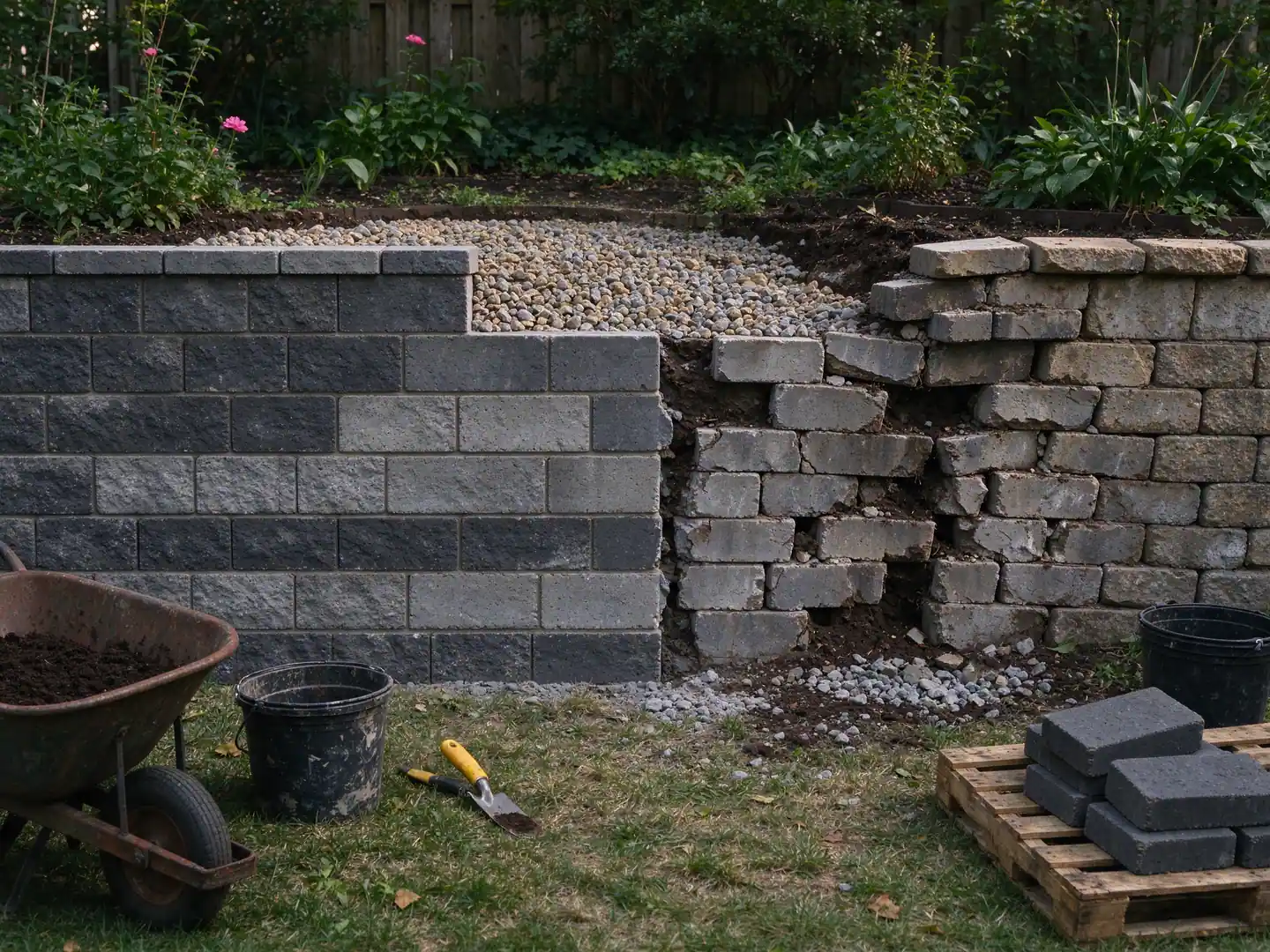
Repair when the wall is stable and the damage is local: cracked mortar, loose stone or block, a failed cap, clogged weep holes. Stabilize with anchors when it leans but the body is sound. Replace when it's rotating at the footing, sliding, failing in several sections or made of rotted timber.
- Minor repair: about $325–$1,600 in NYC (Fixr $250–$1,250 × RSMeans NYC index 129.1).
- Anchoring a lean: about $75–$105 per linear ft; rebuilding: about $90–$160 per linear ft (Fixr × 1.29).
- Work on walls 4 ft+ from the top of the footing, or carrying a surcharge, needs a DOB permit either way (1 RCNY §101-14).
- A Local Law 37 wall rated SREM or Unsafe needs its repair done and certified, whichever route you choose.
NYC Retaining Walls is a licensed and insured retaining wall contractor that repairs, stabilizes and rebuilds retaining walls, and recommends the smallest of those three that actually stops the problem. Retaining wall repair vs replacement isn’t a question of how bad the wall looks; it’s a question of what is failing. A wall with ugly cracks can be structurally stable, and a wall that looks fine from the yard can be rotating at its footing. The comparison below shows the signs and the NYC costs side by side. Our retaining wall repair page explains what each repair involves.
Repair, stabilize or replace: side by side
| Repair | Stabilize (anchors) | Replace | |
|---|---|---|---|
| Wall condition | Plumb and stable | Leaning or bulging, body sound | Rotating, sliding, broken through, or rotted |
| Typical work | Repointing, resetting units, crack repair, new cap, clearing weep holes | Helical, tieback or deadman anchors with face plates, plus drainage | Demolition, new footing, new wall, full drainage zone |
| NYC cost (Fixr × 1.29) | ~$325–$1,600 minor | ~$75–$105 per linear ft | ~$90–$160 per linear ft |
| Yard disruption | Minimal | Moderate, mostly at the face | Excavation behind the wall |
| Permit (4 ft+ or surcharge) | Sometimes | Usually | Yes |
Which signs point to a repair?
A repair is right when the wall is stable and the damage is at the surface or in one spot. Typical signs: mortar joints eroded or cracked, a few loose or spalled stones, a cap that’s shifted, hairline cracks in concrete that aren’t widening, and clogged weep holes on a wall that’s otherwise plumb. The fix is repointing, resetting, crack repair and restoring drainage — and the repair has to deal with why it happened, usually water. See retaining wall drainage repair.
When is stabilizing enough?
When the wall leans or bulges but its body is in one piece — a concrete wall without through-cracks, a mortared stone wall that’s moved as a unit. Anchors tie the wall back into stable soil behind it, and new drainage relieves the pressure that pushed it. It keeps the wall and most of the yard intact and costs less per foot than a rebuild. Measure the lean first and check whether it’s still moving; the leaning wall guide explains how, and leaning retaining wall repair describes the anchors.
Which signs mean it’s time to replace?
- Rotation at the base. The wall tilts from the footing, often with the toe kicking out or soil heaving in front.
- Sliding. The whole wall has moved forward, sometimes visible as a gap at the ends.
- Several failing sections. If the repair scope covers more than about half the wall, price a rebuild alongside it.
- Material at the end of its life. Rotted timber and railroad ties can’t be repaired in any lasting way; see the railroad tie vs. block guide.
- No footing, no drainage. An old dry-laid wall sitting on soil with no drainage behind it may only be fixable by rebuilding.
Retaining wall replacement covers how a rebuild is staged.
How do the costs compare on a real wall?
Take a 40-foot wall, 5 feet high, leaning along its middle 20 feet. Anchoring the 20-foot section costs about $1,500–$2,100 (20 × $75–$105), plus engineering of about $450–$970 and a DOB filing. Rebuilding all 40 feet costs about $3,600–$6,400 (40 × $90–$160), plus demolition, engineering and the filing. If the rest of the wall is sound, the anchor route saves money and keeps the yard; if the whole wall is moving, anchoring half of it doesn’t. Full worked examples are in the repair cost guide and replacement cost guide, and the cost estimator prices both.
What if the wall has a Local Law 37 rating?
If a Qualified Retaining Wall Inspector rated the wall SREM or Unsafe, the report sets the minimum scope, and the repair has to be completed and certified on that report’s timeline — within no more than a year for SREM, within 90 days for Unsafe. Repair or replace, a wall that tall needs a DOB permit for structural work. See the SREM guide and retaining wall violation repair.
What should you ask before deciding?
Ask anyone recommending a fix three questions: what caused the damage, how the proposed work deals with that cause, and what happens to the wall if you choose the cheaper option. A good answer names the mechanism — trapped water, a surcharge, a rotted deadman, a footing that has rotated — and the drainage that goes with the repair. A free site visit gets you both options priced in writing.
Choose the smallest job that actually stops the movement: repair a stable wall, anchor a sound wall that leans, and rebuild a wall whose footing or material has failed. For a written price on both options, (718) 555-0100.
Frequently asked questions.
How long does a repaired retaining wall last compared with a new one?
It depends on whether the repair fixed the cause. Repointing a stone wall whose drainage still works can give it many more years; patching a crack in a wall with water trapped behind it may last one winter. A rebuilt wall with a proper footing, clean drainage stone, filter fabric and a perforated pipe resets the clock entirely. Ask any contractor what caused the damage before comparing prices.
Can part of a retaining wall be replaced instead of the whole thing?
Often, yes. If one run of a longer wall has failed — a section that slid, a block bay that bulged out, a corner undermined by a downspout — it can usually be rebuilt on its own, tied into the sound wall on either side. That costs about $90–$160 per linear foot in NYC, applied only to the failed length. Matching old stone or block is the main challenge.
Does my engineer or my contractor decide repair vs replacement?
For any wall 4 feet or taller, or one carrying a surcharge, the engineer who designs the permitted work makes the structural call, and the contractor prices and builds it. For smaller walls, a contractor can recommend a repair or rebuild, but ask them to explain the cause in writing. If the wall is under Local Law 37, the QRWI's report sets the scope.