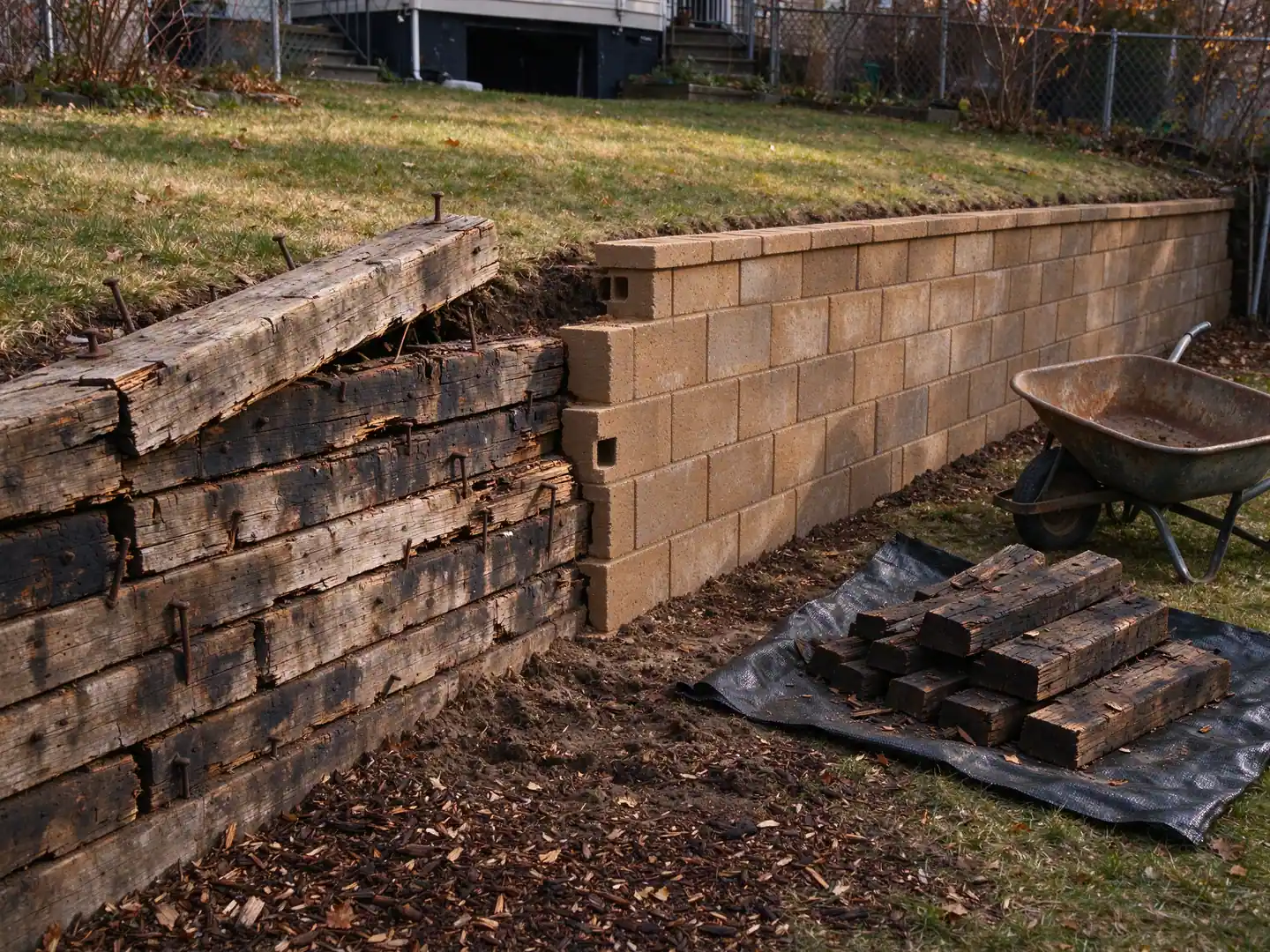
Segmental block is the better choice for almost every new wall. Railroad ties cost about $20 to $40 per square foot of face in NYC and block about $20 to $45, so the up-front gap is small — but timber rots from the back, can't be repaired in any lasting way and leaves creosote-treated ties to dispose of.
- Timber / railroad tie: ~$20–$40 per sq ft of face in NYC (HomeAdvisor $15–$30 × RSMeans NYC index 129.1).
- HomeAdvisor lists railroad-tie walls specifically at $25–$30 per sq ft nationally (about $32–$39 in NYC).
- Segmental block: ~$20–$45 per sq ft of face (HomeGuide $15–$35 × 1.29).
- Either wall needs a DOB permit at 4 ft+ from the top of the footing or with a surcharge (1 RCNY §101-14).
NYC Retaining Walls is a licensed and insured retaining wall contractor that replaces failed timber and railroad-tie walls, usually with segmental block. The railroad tie vs block retaining wall question tends to come up at one of two moments: when someone is building a low garden wall and timber looks cheaper, or when an old tie wall has started to lean and rot. In both cases the comparison is closer on price than people expect and much less close on everything else. Our railroad tie retaining wall replacement page covers taking out an old timber wall.
Railroad tie vs block retaining wall: side by side
| Railroad ties / timber | Segmental block (SRW) | |
|---|---|---|
| NYC cost per sq ft of face | ~$20–$40 (HomeAdvisor × 1.29) | ~$20–$45 (HomeGuide × 1.29) |
| How it fails | Rot from the back and at the anchors; lean | Bulging or settlement if base, geogrid or drainage is wrong |
| Repairable? | Not in any lasting way | Units can be reset or replaced |
| Drainage | Often none; water sits against wood | Designed in: clean stone, fabric, perforated pipe |
| End of life | Creosote-treated ties to haul away | Units can often be reused |
| Height | Low walls | Low to moderate; taller with engineered geogrid |
| Looks | Rustic; weathers gray, then soft | Textured face, many colors, curves easily |
Why do railroad-tie walls fail?
Wood in contact with wet soil decays, and a retaining wall is built to keep wet soil against it. Timber walls usually rot first at the back face and at the deadmen — the perpendicular ties buried in the slope to anchor the wall — so a wall can look sound from the yard while losing its grip on the hill. Freeze-thaw adds to it: Central Park averages about 78 days a year below freezing, and water in rotted wood and soil expands each time. The result is the classic timber failure: the top courses tilt forward, spikes pull out, and soil spills through the gaps. The leaning wall guide explains how to judge how urgent that is.
What does each cost on the same wall?
For a wall 50 feet long and 3 feet high — 150 square feet of face:
- Railroad ties: 150 × $20–$40 = about $3,000–$6,000
- Segmental block: 150 × $20–$45 = about $3,000–$6,750
The up-front difference is small. Replacing a failed timber wall adds removal and disposal of the old ties, and a block wall built properly includes a compacted stone base and a drainage zone — clean crushed stone, filter fabric and a perforated pipe — that most old tie walls never had. At 3 feet with lawn above, neither needs a DOB permit; at 4 feet from the top of the footing, or with a driveway or slope above, both do. The replacement cost guide and the cost estimator give fuller numbers.
When might timber still make sense?
For a very low, temporary edge — a raised bed or a short landscape step where failure would mean nothing more than a little spilled soil. For anything that holds back a meaningful slope, sits near a walkway or a driveway, or has to last, block is the better buy. Avoid building with reclaimed creosote railroad ties near vegetable gardens or play areas.
What replaces a timber wall best?
Usually segmental block: it goes in course by course without curing time, suits the low and terraced walls timber is usually used for, and can follow the same line. On a tight lot with no room for geogrid behind the wall, or where a driveway sits above, a reinforced concrete retaining wall may fit better; the concrete vs. block guide compares the two. On terraced slopes, see hillside retaining walls.
How do you take out an old tie wall safely?
In sections, from the top down, keeping the slope supported as the ties come out — a timber wall that’s leaning is still holding soil. The old ties, spikes and any rebar pins come out, the rotted fill behind them is cut back to sound soil, and the new base goes in. Ask how disposal is handled and whether it’s a separate line on the price. If the old wall is 4 feet or taller from the top of the footing, or holds up a driveway, the new one needs a DOB permit and stamped plans; see the permit guide. Not sure how far gone your timber wall is? The wall assessment walks through the signs, and driveway retaining walls covers walls that carry cars.
Railroad ties save little up front and cost more at the end, so for a new or replacement wall, segmental block on a compacted base with real drainage is usually the better buy. For a price on replacing your timber wall, (718) 555-0100.
Frequently asked questions.
Can I just replace the rotted railroad ties in my wall?
You can swap a few, but it rarely lasts. Timber walls usually rot from the back, where the ties sit against wet soil, and from the deadmen or anchors that hold them, so a tie that looks sound on the face may be soft behind. Replacing visible ties leaves the hidden rot in place. When several ties are soft or the wall is leaning, replacement is the lasting fix.
What happens to the old railroad ties?
They have to be removed and hauled away. Old railroad ties are commonly treated with creosote, which limits how they can be reused or disposed of, so ask your contractor how and where the ties will go and whether disposal is a line item on the price. Don't burn them or cut them up for garden beds.
Does a block wall replacing timber need a permit?
Only if it crosses the line in 1 RCNY §101-14: 4 feet or taller measured from the top of the footing, or supporting a surcharge such as a driveway, a building or sloped ground. Many timber walls are 2 to 3 feet tall with lawn above and can be replaced without a filing. Taller or loaded walls need stamped plans from a licensed engineer or architect.