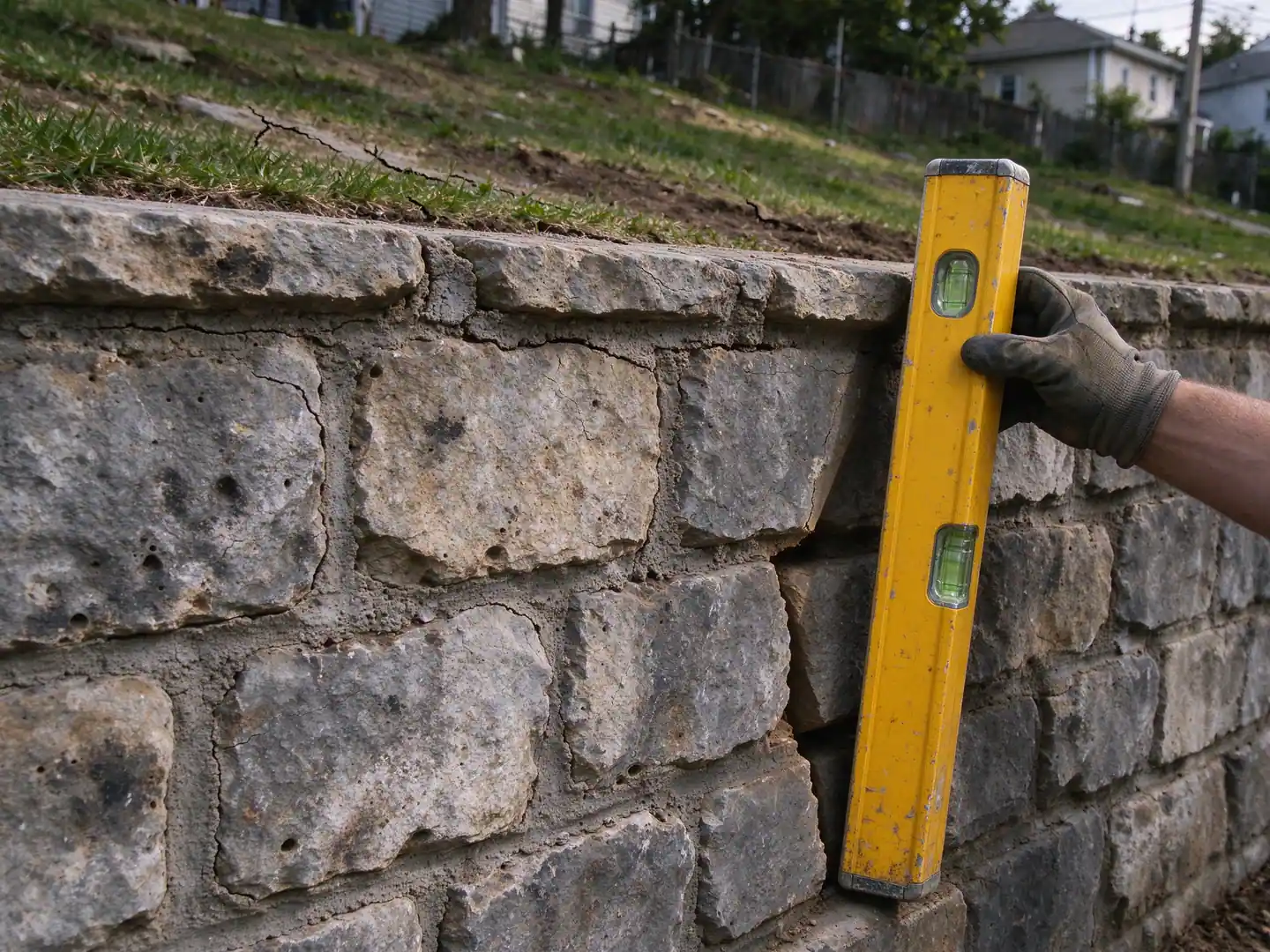
It can be. DOB lists leaning as a warning sign that warrants evaluation by a licensed engineer or architect. Whether a lean is dangerous depends less on the angle than on whether it's getting worse, how tall the wall is and what's below it. An increasing lean, or one with bulging or soil cracks at the top, needs prompt attention.
- DOB lists leaning, bulging, swelling at the base and cracks in the soil at the top as retaining wall warning signs.
- No code sets a maximum lean; ongoing movement matters more than the angle.
- Anchoring a leaning section: about $75–$105 per linear ft in NYC (Fixr $60–$80 × RSMeans 129.1).
- Rebuilding a section: about $90–$160 per linear ft (Fixr $70–$125 × 1.29).
NYC Retaining Walls is a licensed and insured retaining wall contractor that stabilizes and rebuilds leaning walls across the five boroughs. Is a leaning retaining wall dangerous? Sometimes — and the useful question is whether it’s still moving. DOB lists leaning among the warning signs that call for an evaluation by a licensed engineer or architect, but no code sets a maximum angle. A wall that leaned years ago and stopped is a planned repair; a wall that’s leaning further each season is a wall heading toward failure. Our leaning retaining wall repair page covers the fixes.
Which signs are urgent, and which can wait?
Call 311 now, and keep people away, if:
- The wall is visibly moving, or the lean changed noticeably after a storm or a thaw.
- Soil, stones or block are falling from it, or there’s a fresh crack in the ground or pavement at the top.
- It leans over a sidewalk, a driveway, a play area or a neighbor’s house.
- The base is swelling or kicking out, or the wall has separated from an adjoining wall or step.
If anyone is in danger, call 911. The collapse guide covers what to do next.
Get it assessed soon if:
- The lean comes with bulging, stepped cracks in block, or open mortar joints.
- Water seeps from the face instead of the weep holes, or the soil above stays wet.
Monitor if:
- A short wall has a slight, old lean, no new cracks, and nothing important below it.
How do you measure a lean?
Hold a 4-foot level against the face at three or more points along the wall, with the bottom of the level touching the wall, and measure the gap at the top. Write the numbers down, mark the spots with paint or a nail, and take photos with something for scale. Repeat after heavy rain and after a freeze-thaw stretch — Central Park averages about 78 days a year below freezing. A gap that grows is the signal that matters. The wall assessment walks you through the rest of the checklist.
Why do retaining walls lean?
Three causes cover most leans in New York City.
- Water. Soil that can’t drain gets heavier and pushes harder. Clogged weep holes and no drainage stone behind the wall are the most common culprits; see the weep holes guide.
- Surcharge. A driveway, parked cars, a shed or regrading along the top adds load the wall may never have been designed for. Under 1 RCNY §101-14, a wall carrying a surcharge needs a DOB permit at any height — a sign of how seriously the code treats it. See driveway retaining walls.
- Age and material. Timber and railroad-tie walls rot from the back; old dry-laid stone walls lose their footing. A rotted timber wall rarely repairs well — see railroad tie retaining wall replacement.
How is a leaning wall fixed, and what does it cost?
If the body of the wall is sound, anchoring usually costs far less than a rebuild: helical anchors, tiebacks or deadman anchors installed through or behind the wall, with plates on the face, at about $75–$105 per linear foot in NYC (Fixr’s $60–$80 × RSMeans NYC index 129.1). If the wall is rotating at the footing, cracked through, or timber, rebuilding the section at about $90–$160 per linear foot is the lasting fix. Either way, drainage gets fixed too. Work on walls 4 feet or taller from the top of the footing needs a DOB permit and stamped plans. The repair vs. replacement guide helps you choose, and the cost estimator gives a starting range.
Does fixing a leaning wall need a permit?
Usually, if the wall is big enough to matter. Anchoring or rebuilding a wall that’s 4 feet or taller from the top of the footing, or one holding up a driveway, building or slope, is structural work that needs a DOB permit with plans by a licensed engineer or architect (1 RCNY §101-14). A short garden wall with lawn above can usually be reset or rebuilt without a filing. Our retaining wall repair and retaining wall replacement pages explain how each job is scoped and permitted.
Is a leaning wall on the property line your problem?
Partly. A wall on the common lot line is a joint responsibility, half each, under Admin Code §28-305.1.1; a wall wholly on one lot belongs to that owner. Low lot-line walls often show their lean only when a fence comes down. See shared retaining wall repair before you agree on a fix with your neighbor.
Measure the lean, mark it and check it again in a few weeks: a wall that's stable can usually wait for a planned repair, and a wall that's moving can't. To have your wall measured and get a written price, (718) 555-0100.
Frequently asked questions.
How much lean is too much for a retaining wall?
There's no code number. NYC's rules and DOB's guidance treat leaning as a warning sign that calls for a professional evaluation, not as a measured limit. Engineers look at the trend — is it moving — along with the wall's height, what it holds back and what's in front of it. A short garden wall that has leaned slightly for decades is a different problem from a tall wall that moved this year.
Can a leaning retaining wall be straightened?
Rarely, and usually not worth trying. Pulling a masonry or concrete wall back to plumb risks cracking it. The usual fix is to stop the movement where it is — with helical anchors, tiebacks or deadman anchors that tie the wall back into stable soil, plus drainage to relieve water pressure — or to rebuild the failed section on a proper footing.
Is my leaning wall covered by Local Law 37?
Only if it's 10 feet or taller at some point, measured including any parapet or fence, and fronts a public right-of-way. If it is, a Qualified Retaining Wall Inspector's report would note the lean, and a significant lean can lead to an SREM or Unsafe rating, each with its own deadline. Smaller private walls aren't in the program, but the owner must still keep them safe.