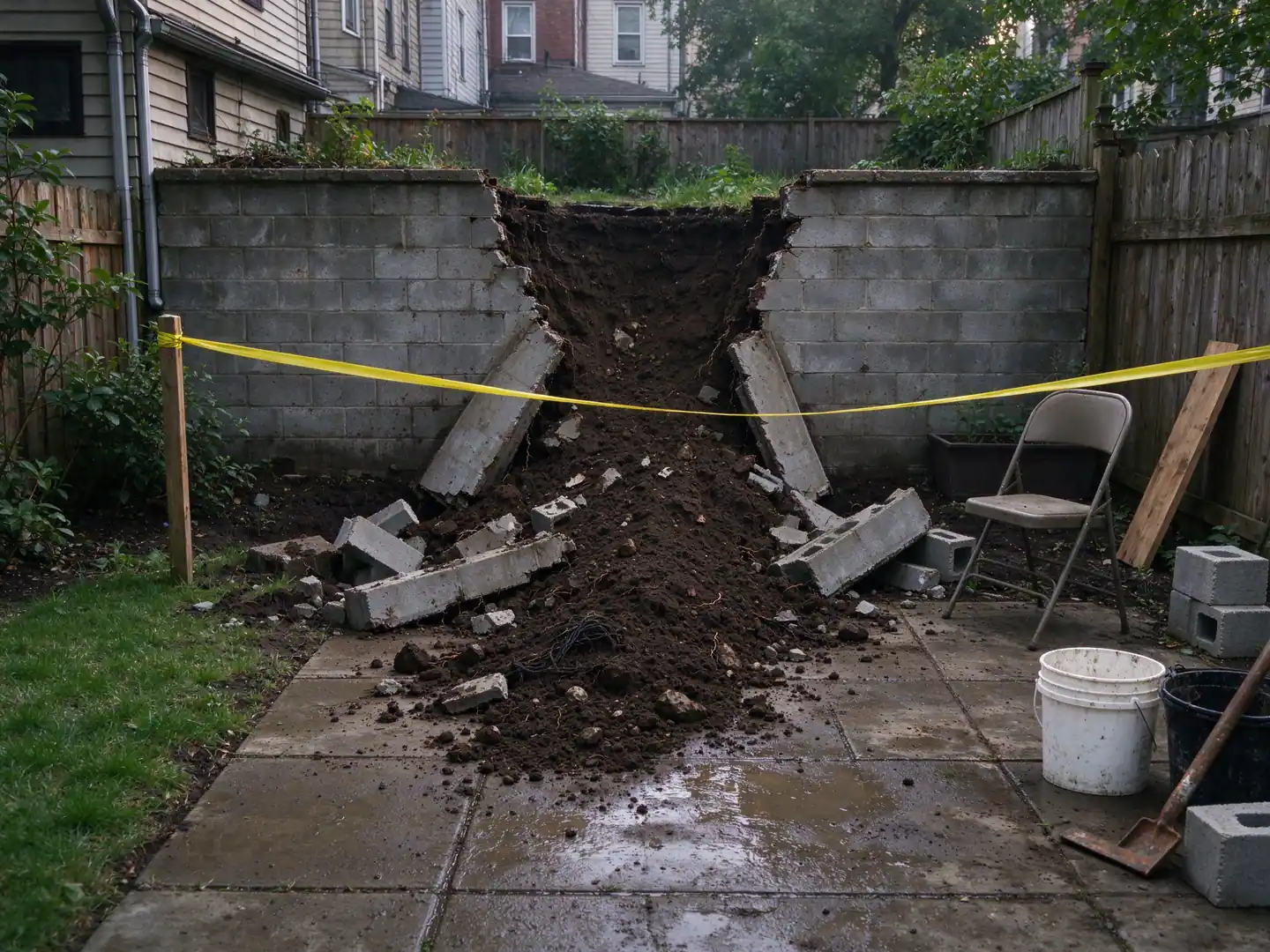
If a retaining wall has collapsed, keep everyone away from the debris and the remaining wall, call 911 if anyone is hurt or a building, gas line or street is threatened, and call 311 to report it to DOB. Then photograph everything, notify your insurer, and have an engineer assess what's left before anyone digs.
- Unsafe retaining walls are reported to DOB through 311 (212-NEW-YORK) (DOB; Admin Code §28-305.4.6).
- After the Jan 10, 2024 Tremont wall collapse in the Bronx, DOB issued full vacate orders to three buildings (Bronx Times).
- After a 9-ft wall collapse in Sunset Park in Dec 2020, DOB issued a partial vacate on both backyards; no permits had been issued for the work (NY1).
- Rebuilding a failed section in NYC: about $90–$160 per linear ft (Fixr $70–$125 × RSMeans 129.1).
NYC Retaining Walls is a licensed and insured retaining wall contractor that stabilizes and rebuilds failed walls across the five boroughs. Retaining wall collapsed? What to do comes in a fixed order: people first, then reporting, then records, then the wall. A collapse rarely ends with the first slide — the soil behind it and the sections still standing have just lost support. The steps below follow that order. Our retaining wall violation repair page covers the work that follows a DOB order.
Who do you call first?
Call 911 now if:
- Anyone is hurt or trapped.
- Debris or soil has hit a house, a garage with people in it, a car on the street, or a sidewalk in use.
- A gas line, electrical service or water main may be damaged — and stay away from it.
Call 311 (212-NEW-YORK) today if:
- The collapse threatens a building, a sidewalk, a street or a neighbor’s property.
- The remaining wall is cracking, leaning or shedding soil.
- The wall is shared, or you’re not sure whose it is.
DOB takes retaining wall reports through 311 and can inspect, order the area protected, and issue violations or vacate orders.
This can wait a day or two: choosing a contractor, getting rebuild prices and deciding on materials.
What should you do in the first 24 hours?
- Keep everyone back — from the debris, the face of what’s still standing and the ground at the top, where new cracks may open. Tape it off; keep children and pets away.
- Don’t dig out the debris. It may be holding back soil. Removing it from the toe can bring down more.
- Divert water. Turn off irrigation, redirect downspouts and, if it’s safe, cover exposed soil with tarps so rain doesn’t saturate it further.
- Document everything with dated photos and video: the wall, the soil, damage to the house or the neighbor’s property, and anything that may have caused it.
- Notify your insurer. Most collapses from soil or water pressure aren’t covered, but a sudden event may be, and late notice can hurt a claim. See the insurance guide.
What does DOB do after a collapse?
DOB inspects and acts on what it finds. After a 150-foot section of wall collapsed in Tremont in the Bronx on January 10, 2024, the Bronx Times reported full vacate orders on three Anthony Avenue buildings, and DOB said the owners had never filed repair applications despite a partial vacate order in place since 2020. After a 9-foot retaining wall collapsed in Sunset Park in December 2020 and killed a worker, NY1 reported DOB found no permits for the work and issued a partial vacate on both backyards. If your wall is 10 feet or taller and fronts a public right-of-way, it’s also in the Local Law 37 program, and an Unsafe condition must be corrected within 90 days; see the Local Law 37 guide.
Who is responsible for the rebuild?
The survey decides. A wall wholly on one lot belongs to that owner; a wall on the common lot line is a joint responsibility, half each (Admin Code §28-305.1.1). If a neighbor’s project caused the collapse, that changes the conversation — keep your records and consider talking to an attorney. See the neighbors guide and shared retaining wall repair.
How is the wall stabilized and rebuilt?
First, an engineer or experienced contractor stabilizes what’s left — temporary shoring, regrading the slope back, or removing loose sections in a controlled order. Then the rebuild is designed. Any wall 4 feet or taller from the top of the footing, or one that supports a driveway, building or slope, needs a DOB permit and stamped plans (1 RCNY §101-14). In NYC, rebuilding typically runs about $90–$160 per linear foot, and a new wall about $20–$65 per square foot of face depending on material (Fixr and HomeGuide national figures × RSMeans NYC index 129.1). The replacement cost guide has worked examples, and retaining wall replacement explains the work. The rebuild should include what the old wall likely lacked: ¾-inch clean stone, filter fabric and a perforated drain — see retaining wall drainage repair. For a starting number before the site visit, use the cost estimator; the Bronx page covers the borough of the 2024 Tremont collapse.
After a collapse, get people clear, report it, document it and let an engineer decide what's safe before anything is moved; the rebuild comes after that. For an assessment and a written rebuild price, (718) 555-0100.
Frequently asked questions.
Should I clear the debris myself?
Not right away. Debris from a collapsed retaining wall is often holding back soil that would otherwise slide, and the wall sections still standing may have lost support. Removing material from the toe can trigger a second failure. Keep people clear, photograph everything, and let an engineer or experienced contractor say what can be moved, in what order and with what shoring.
Who pays to rebuild a collapsed retaining wall?
The owner of the lot it sits on — or both owners, half each, if it was on the common lot line (Admin Code §28-305.1.1). Insurance usually doesn't pay when the cause was soil movement, water pressure or age, but it may when a sudden event like a vehicle or falling tree caused the collapse. A survey settles ownership if there's any doubt.
Will DOB issue a violation after a collapse?
It can. DOB inspects after reported collapses and may issue violations, stop-work orders or vacate orders for affected buildings or yards, as it did after collapses in Tremont in 2024 and Sunset Park in 2020. Rebuilding usually needs a DOB permit with stamped plans when the wall is 4 feet or taller or carries a surcharge.
- NYC DOB — Retaining walls: information for property owners
- NYC DOB — Retaining wall FAQs (unsafe conditions)
- Bronx Times — Vacate orders after Tremont retaining wall collapse (Jan 2024)
- NY1 — One dead after wall collapses in Sunset Park (Dec 28, 2020)
- Fixr — Retaining wall repair cost (updated Jan 31, 2025)