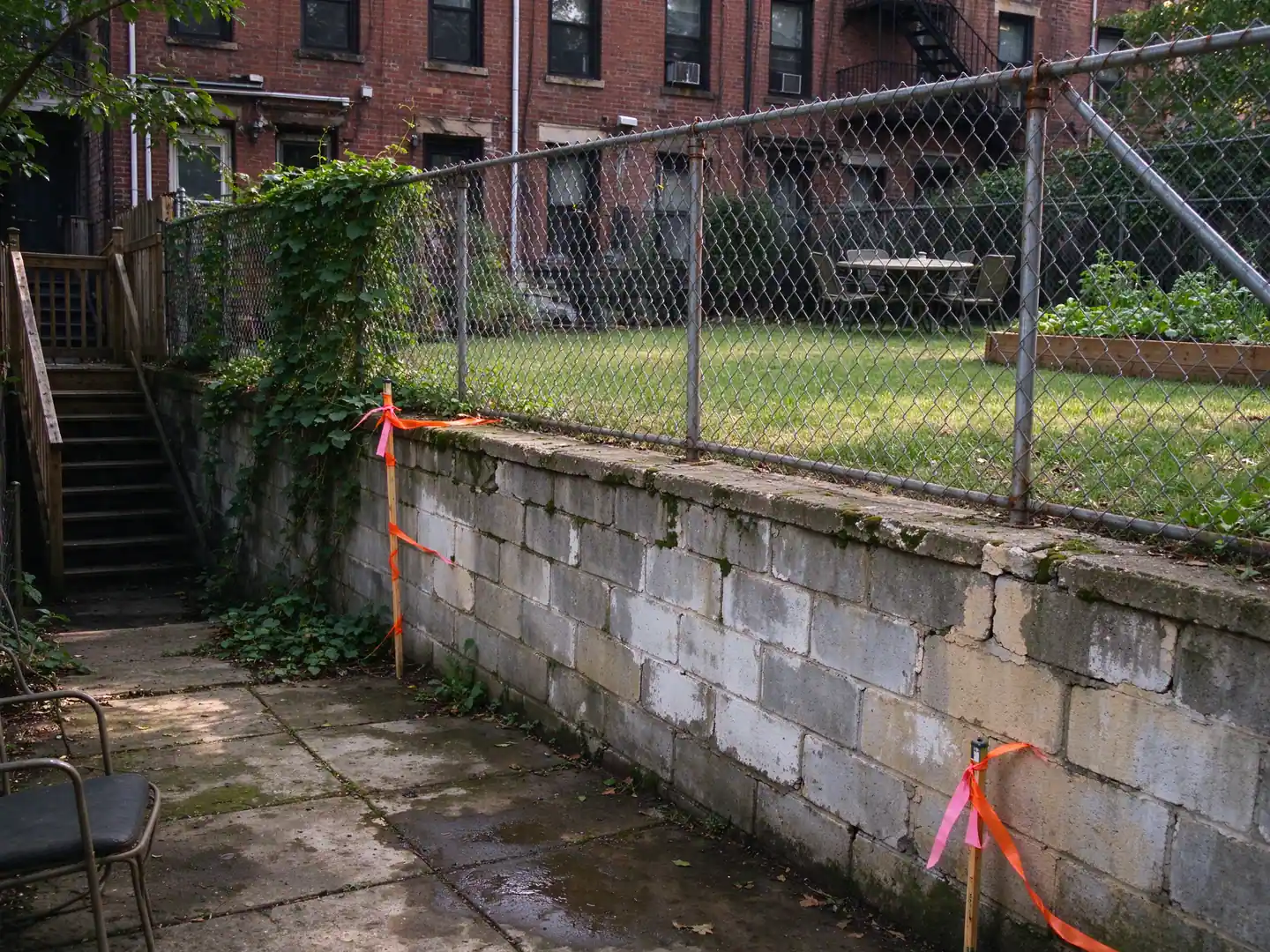
In NYC, the survey decides. A retaining wall wholly on one lot belongs to that owner, and the neighbor must allow access for repairs (Admin Code §28-305.1.2). A wall on the common lot line is a joint responsibility, with each owner paying half unless they agree otherwise (§28-305.1.1). High or low side makes no difference.
- Wall on the common lot line: joint responsibility, half each unless the owners agree otherwise (Admin Code §28-305.1.1).
- Wall wholly on one lot: that owner's; the neighbor must allow access for repairs (§28-305.1.2).
- Owner who changes the grade builds and maintains the wall on their own land at their own cost (§28-305.2).
- High side or low side makes no difference — only location relative to the lot line (DOB FAQ).
NYC Retaining Walls is a licensed and insured retaining wall contractor that repairs and rebuilds walls on property lines, where the first question is always who pays. Who is responsible for a retaining wall between neighbors in NYC is answered by Article 305 of the city’s Administrative Code, and the deciding fact is the wall’s location on a survey — not who built it, not who uses it, and not which side the soil is on. Our shared retaining wall repair page covers doing the joint work; this guide covers the rules.
What does the Admin Code say?
| Where the wall sits | Who’s responsible | Code section |
|---|---|---|
| Wholly on your lot | You — and your neighbor must allow access for repairs | §28-305.1.2 |
| Wholly on your neighbor’s lot | Your neighbor | §28-305.1.2 |
| On the common lot line, partly on both | Both owners, half each, unless you agree otherwise | §28-305.1.1 |
| Built because one owner changed the grade | The owner who changed the grade, on their own land, at their own cost | §28-305.2 |
| Covered by a written agreement | As the agreement says | §28-305.3 |
Two more rules matter on a shared wall. An owner who temporarily removes a lot-line wall must protect the neighbor’s property and replace the wall at their own cost (§28-305.1.1). And DOB’s FAQ is explicit that being on the high side or low side makes no difference — only location relative to the lot line counts.
How do you find out where the wall sits?
With a survey from a New York State-licensed land surveyor. DOB doesn’t keep private surveys, and a Qualified Retaining Wall Inspector can rate a wall’s condition but can’t settle who owns it. If the survey is old or doesn’t show the wall, ask for an updated one that locates the wall’s face and footing relative to the lot line.
What if the wall runs behind several houses?
Then several owners may share it. When a Bronx retaining wall was flagged in 2020, NY1 reported that DOB ordered 13 owners to hire a geotechnical engineer — and one long-time resident said they had no idea who the wall belonged to. In Inwood in 2011, DOB declared a roughly 10-foot wall shared by 11 buildings unsafe and said everyone abutting it was responsible (DNAinfo). Courts have split costs among the lots that touch the damaged section: in 230-79 Equity Corp. v. Mancuso (2d Dept 2012), the court apportioned repair costs that way. One engineer’s report and one contract covering the whole damaged run, with each owner’s share written in, is usually cheaper than separate jobs; the replacement cost guide shows typical numbers.
What about Local Law 37 on a shared wall?
If the shared wall is 10 feet or taller at any point and fronts a public right-of-way, both owners are responsible for the five-year inspection. DOB lets one QRWI cover the whole wall, but each owner pays the $355 filing fee. Penalties for not filing now run $5,000 a year under the rule effective March 23, 2025. See the Local Law 37 guide.
What should neighbors do first?
- Get or update the survey, and share it.
- Get the wall assessed — what’s wrong, why, and what it costs. Our retaining wall repair page explains what a site visit covers.
- Put the split in writing before work starts, even if it’s the default 50/50. §28-305.3 lets owners agree to something else.
- Agree on access — the contractor will usually need both yards. If a neighbor refuses, see the neighbor access guide.
If a neighbor’s project has cracked or pushed a shared wall, or it looks like it could fall, call 311 — DOB can inspect and issue a stop-work order. If someone is hurt or a structure is threatened, call 911. If a shared wall has already come down, the collapse guide covers the first 24 hours, and retaining wall replacement covers rebuilding it with one contract for both owners.
Is the rule different outside NYC?
Yes. The 50/50 rule is in New York City’s Administrative Code. Elsewhere in New York State, disputes over walls between properties generally turn on common-law rules about lateral support and nuisance, and on any recorded agreements. Within the five boroughs, the Admin Code governs — on a Staten Island hillside or a Queens side yard alike.
Get a survey before you argue about money: it decides whether the wall is yours, your neighbor's or both, and the Admin Code fills in the rest. For a single repair scope both owners can sign, (718) 555-0100.
Frequently asked questions.
Does it matter if I'm on the high side or the low side of the wall?
No. DOB's retaining wall FAQ answers this directly: what matters is where the wall sits relative to the lot line, not which owner's soil it holds back. A wall wholly on the low-side lot belongs to the low-side owner even though it supports the neighbor's yard, unless the high-side owner changed the grade — in which case §28-305.2 puts the wall on them.
Can I backfill against my neighbor's retaining wall?
No. DOB's FAQ says that if you want to raise or level your yard against a wall that sits fully on the adjoining lot, you need to build your own wall on your own property to hold your grade change. Admin Code §28-305.2 makes the owner who changes the grade responsible for building and maintaining that wall, entirely on their own land, at their own cost.
Will my insurance cover damage my wall does to my neighbor's property?
Possibly, under the liability part of a homeowners policy, if the neighbor alleges you were negligent — but insurers contest these claims, and the outcome depends on your policy and the facts. Your own wall's collapse is usually excluded as earth movement or water pressure. Tell your carrier promptly and get advice from the insurer or an attorney before admitting fault.