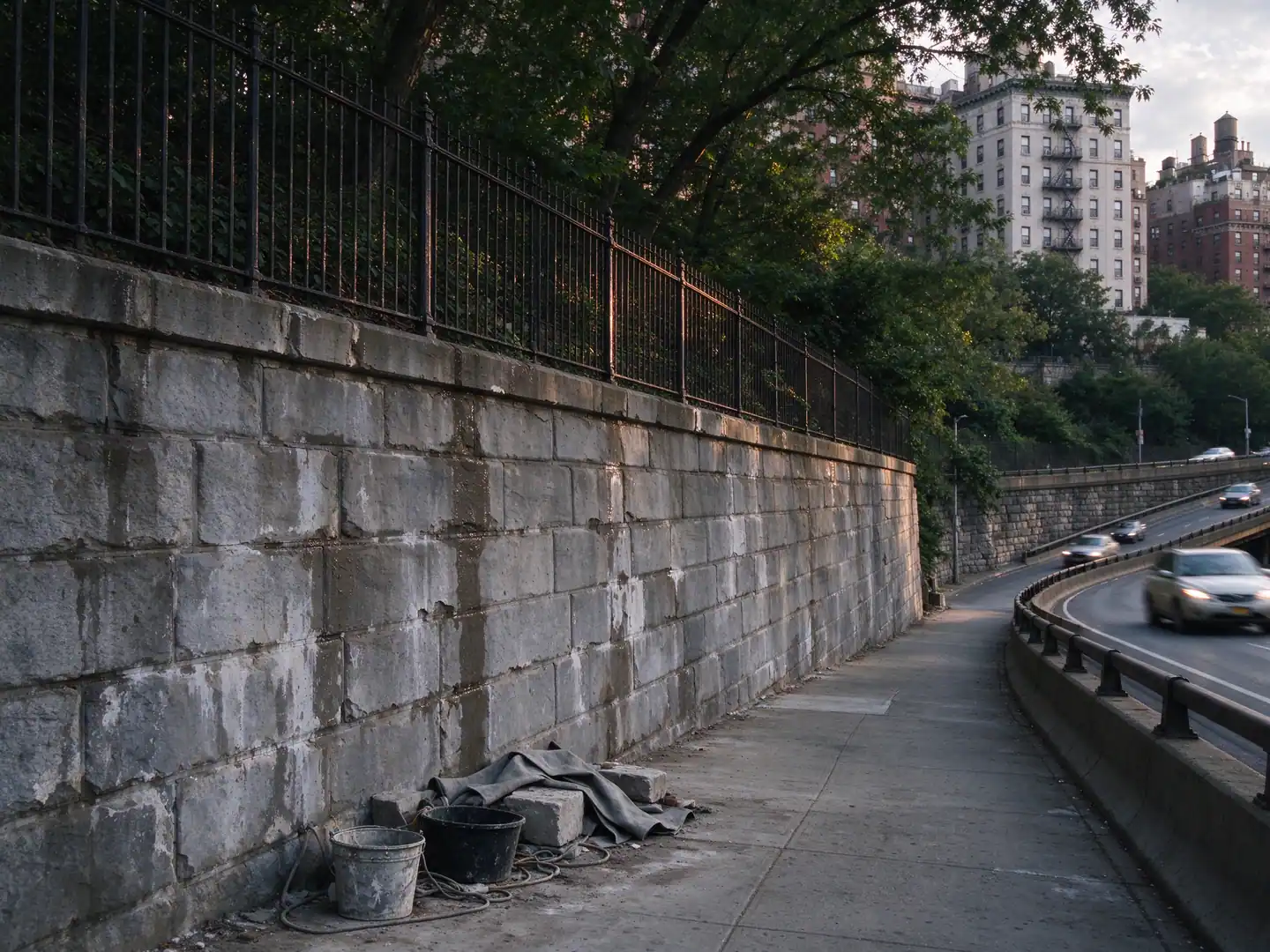
Local Law 37 of 2008 requires owners of retaining walls 10 feet or taller at any point that front a public right-of-way to have them inspected every five years by a Qualified Retaining Wall Inspector. The TR16 report is due within 60 days of the inspection and rates the wall Safe, Safe with minor repairs, SREM or Unsafe.
- Covers walls 10 ft+ at any point fronting a public right-of-way, measured including parapets or fencing (Admin Code §28-305.4).
- Inspector must be a QRWI: a NYS-licensed PE with 3 years of retaining-wall experience — not an architect (1 RCNY §101-07).
- Cycle 3 windows: Bronx 2024, Manhattan 2025, Staten Island 2026, Queens 2027, Brooklyn 2028 (1 RCNY §103-09).
- Failure to file: $5,000 a year; late filing: +$1,000 a month (rule effective Mar 23, 2025).
NYC Retaining Walls is a licensed and insured retaining wall contractor that repairs walls to the findings of Local Law 37 reports; we don’t sign the reports, and we can connect owners with an independent inspector. The Local Law 37 retaining wall program grew out of the May 12, 2005 collapse of the private Castle Village wall in Hudson Heights onto the Henry Hudson Parkway. Today it’s codified at Admin Code §28-305.4 and run under DOB rule 1 RCNY §103-09. Here is what it requires, in order. The process side is on our retaining wall inspection page.
Which walls does Local Law 37 cover?
A wall is covered if it is 10 feet or taller at any point and fronts a public right-of-way. Height runs from the ground at the front of the wall to the top, including any parapet or fencing that retains material — so a wall retaining 6 feet of soil with a parapet bringing it over 10 feet still counts. The rule defines public right-of-way as a public highway, railroad, street, avenue, alley, public driveway, sidewalk, roadway or any other public place. Basement and vault walls that are part of a building are excluded.
DOB’s FAQ adds two practical points: a wall that ranges from 4 to 12 feet is covered if any portion reaches 10 feet, and a wall in a private courtyard or parking lot counts if the public can freely walk up to it. A wall under 10 feet beside a sidewalk needs no TR16, but the owner’s general duty to keep it safe still applies.
Who can inspect, and what’s in the report?
Only a Qualified Retaining Wall Inspector: a New York State-licensed professional engineer with three years of relevant experience with walls over 10 feet (1 RCNY §101-07). A registered architect can’t sign the TR16. The report and structural assessment must be filed within 60 days of the inspection and can’t be filed more than a year after it. If no drawings exist, DOB requires probes, cores or test pits, a cross-section and calculations.
What do the four ratings mean?
| Rating | What it means | What the owner must do |
|---|---|---|
| Safe | No action needed | File and wait for the next cycle |
| Safe with minor repairs or maintenance | Small items | Do them before the next inspection |
| SREM — Safe with Repairs and/or Engineering Monitoring | Repairs or monitoring needed within no more than one year | Repair or monitor; can’t stay SREM two cycles running |
| Unsafe | A hazard to the public or property | Inspector notifies owner and DOB immediately (311); protect the public; correct within 90 days; file an amended report |
An SREM condition still uncorrected at the next inspection must be reported Unsafe. The SREM guide covers the timeline, and retaining wall violation repair covers the work.
When is each borough’s report due?
Each borough files in a one-year window that repeats every fifth year. Cycle 3 runs January 1, 2024 to December 31, 2028:
| Borough | Cycle 3 window | Next window (Cycle 4) |
|---|---|---|
| Bronx | 2024 (closed) | 2029 |
| Manhattan | 2025 (closed) | 2030 |
| Staten Island | 2026 — due Dec 31, 2026 | 2031 |
| Queens | 2027 | 2032 |
| Brooklyn | 2028 | 2033 |
Staten Island owners have weeks left; see the Staten Island deadline guide and our Staten Island page. A new wall’s first report is due five years after its first work permit if that falls in the borough’s window, otherwise in the next window.
What does it cost, and what are the penalties?
DOB’s filing fees are $355 for the initial report, $130 for an amended report and $260 for an extension request, paid by each owner even when one report covers a shared wall. The inspector’s fee isn’t published; the inspection cost guide explains what drives it. Under the rule effective March 23, 2025: failure to file is $5,000 a year, late filing adds $1,000 a month, failing to correct an Unsafe wall is $1,000 a month prorated daily, and an uncorrected SREM later rated Unsafe is a one-time $2,000. DOB’s own web page still lists the older, lower amounts.
How do I find out if my wall is covered?
Look up your address in DOB’s Building Information System, which flags properties with covered walls on the property profile. If the wall may belong to a neighbor, a railroad or the city, a licensed surveyor’s signed and sealed survey settles it — see walls next to subway tracks and the Queens and Brooklyn pages for those boroughs’ upcoming windows.
If any part of your wall is 10 feet or taller and the public can walk or drive past it, Local Law 37 applies: hire a QRWI before your borough's window closes and fix what the report finds. For repairs to your inspector's report, (718) 555-0100.
Frequently asked questions.
My wall ranges from 4 to 12 feet tall. Do I have to file?
Yes. DOB's FAQ says that if any portion of a continuous wall is 10 feet or taller and it fronts a public right-of-way, the whole wall is covered. Height is measured from the ground in front of the wall to the top, including any parapet or fencing that retains material. A wall under 10 feet everywhere doesn't need a TR16, though the owner must still keep it safe.
Does a parking lot or courtyard count as a public right-of-way?
It can. The rule defines a public right-of-way broadly — streets, sidewalks, alleys, railroads, public driveways and any other public place. DOB's FAQ says a wall counts if an unaffiliated member of the public can freely walk up to it, even on private land. A parking lot kept behind a gate that is closed at all times, with occupant-only access, can take a wall out of the program.
Does DOB inspect my retaining wall for me?
No. The owner is responsible for hiring a Qualified Retaining Wall Inspector and filing the report. DOB maintains a list of approved QRWIs and reviews the filings, and its Building Information System flags properties with covered walls, but it does not perform the five-year condition assessment on private walls.