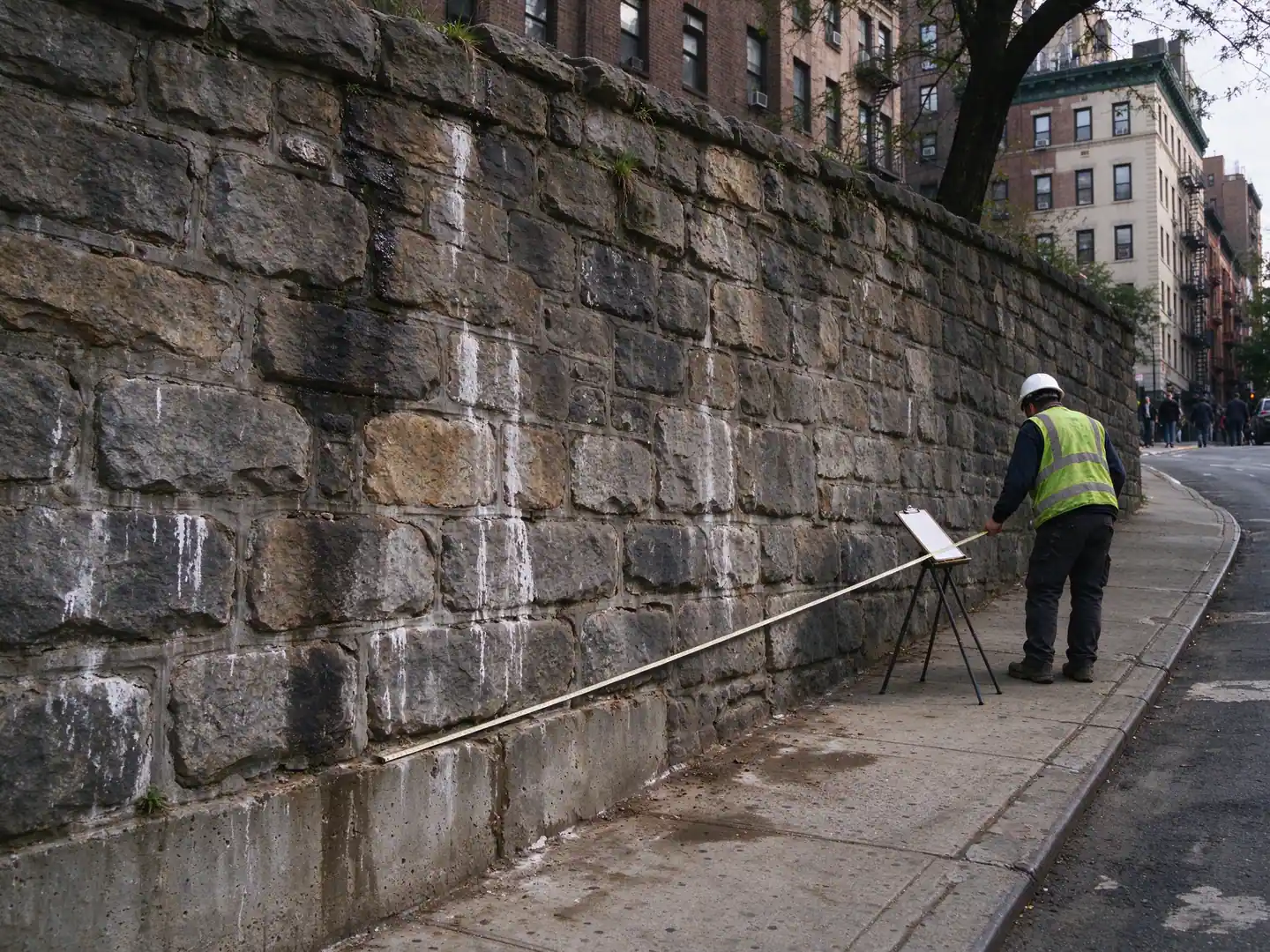
There is no published price for a Local Law 37 retaining wall inspection in NYC. Each Qualified Retaining Wall Inspector quotes the job based on the wall's length and height, access, whether drawings exist and how many owners share it. DOB's filing fees are fixed: $355 initial, $130 amended, $260 extension.
- No public price exists for an LL37 (TR16) inspection — each QRWI quotes by scope.
- DOB filing fees: $355 initial report, $130 amended report, $260 extension request (DOB).
- On a shared wall, one QRWI can cover several owners, but each owner pays the filing fee (DOB).
- Not filing now costs $5,000 a year, plus $1,000 a month for a late filing (1 RCNY §103-09, effective Mar 23, 2025).
NYC Retaining Walls is a licensed and insured retaining wall contractor that repairs walls to the findings of a Local Law 37 report — and the first thing owners ask is what that report costs. The honest answer on retaining wall inspection cost in NYC: no published price exists. Each Qualified Retaining Wall Inspector (QRWI) quotes by scope, and we won’t invent a range. What we can give you is everything that’s fixed — DOB’s fees and penalties — and the factors that move an inspector’s quote, so you can compare quotes on equal terms. Our retaining wall inspection page explains how we connect owners with an independent QRWI.
What DOB charges, and what it fines
| Item | Amount | Source |
|---|---|---|
| Initial TR16 report filing | $355 per owner | DOB retaining wall page |
| Amended report (after repairs) | $130 | DOB |
| Extension request (repair time) | $260 | DOB |
| Failure to file | $5,000 per year | 1 RCNY §103-09, effective Mar 23, 2025 |
| Late filing | +$1,000 per month after the window closes | 1 RCNY §103-09 |
| Failure to correct an Unsafe wall | $1,000 per month, prorated daily | 1 RCNY §103-09 |
DOB’s own web page still shows the older penalties ($250 a month late, $1,000 a year for not filing); the rule text above is the controlling version.
What drives an LL37 inspection quote?
Five things set the inspector’s fee, roughly in this order.
- Length and height. The inspector walks and documents the full wall. A 300-foot wall along a hillside street is more field time than a 40-foot wall behind a garage.
- Drawings, or the lack of them. DOB’s FAQ says a QRWI can’t omit or assume dimensions. Without original plans, the report needs probes, cores or test pits, at least one cross-section with calculations, and a global stability analysis on steep slopes. This is usually the largest swing in price.
- Access. A wall above a sidewalk, a parkway or a railroad cut may be hard to reach from the face side.
- Survey. If ownership is unclear, a licensed land surveyor’s signed and sealed survey may be needed first. DOB doesn’t keep private surveys.
- Number of owners. One QRWI can cover a continuous wall shared by several owners, which spreads the inspector’s fee, though each owner still pays the $355 filing fee.
How does that compare with a general wall inspection?
Fixr lists a general retaining wall inspection at $150–$300 nationally (about $195–$390 adjusted by the RSMeans NYC index of 129.1). That is a visual look, not a Local Law 37 condition assessment, and it doesn’t satisfy the law. Fixr also lists structural engineers at $100–$200 an hour nationally (about $130–$260 in NYC), which gives a sense of how field time and calculations add up on a complex wall.
What do you get for the fee?
A filed TR16 report and a structural assessment, submitted within 60 days of the inspection, that rates the wall Safe, Safe with minor repairs or maintenance, SREM, or Unsafe. If the rating calls for work, the repair is a separate cost: minor repairs in NYC typically run about $325–$1,600 and anchoring about $75–$105 per linear foot (Fixr national figures × 1.29). The SREM rating guide explains the timelines, and retaining wall violation repair covers the work after a poor rating.
How to compare QRWI quotes
Ask each inspector, in writing: Does the quote include probes or test pits if no drawings exist? Is the cross-section and calculation package included? Who pays DOB’s filing fee? What happens if DOB rejects the report — the rule requires revisions within 45 days? Is a re-inspection after repairs a separate fee?
Then check timing. Staten Island’s Cycle 3 window closes December 31, 2026; see the Staten Island deadline guide and our Staten Island service area page. Queens follows in 2027 and Brooklyn in 2028. The full rules are in the Local Law 37 guide.
Can you lower the cost?
A few things reliably shrink the inspector’s job or your share of it:
- Share one inspector. On a continuous wall behind several houses, one QRWI and one site visit for all owners spreads the field time. A lot-line wall is a joint responsibility anyway (Admin Code §28-305.1.1); see shared retaining wall repair.
- Find the paperwork first. Original drawings, an earlier TR16 and a current survey can replace probes and test pits.
- Check whether the wall is really covered. DOB’s FAQ says a wall in a lot that’s gated and closed to the public at all times doesn’t front a public right-of-way, and a licensed engineer may lower a non-retaining parapet or fence below 10 feet as permitted work.
- File on time. Owners in Queens (2027) and Brooklyn (2028) can book inspectors before the end-of-window rush.
Budget for the inspector's quote plus DOB's $355 filing fee per owner, ask any QRWI exactly what the quote includes, and remember that the penalties for not filing are far larger than either. To be connected with an independent QRWI, (718) 555-0100.
Frequently asked questions.
Why won't anyone give me a flat price for a TR16 inspection?
Because the work varies more than the paperwork. DOB's FAQ says the inspector can't simply assume dimensions: if no drawings exist, the report needs probes, cores or test pits, at least one cross-section with calculations, and a global stability analysis where slopes are steep. A short concrete wall with original plans and a 300-foot rubble wall with none are very different jobs.
Can a contractor do my Local Law 37 inspection?
No. The TR16 report must be signed by a Qualified Retaining Wall Inspector — a New York State-licensed professional engineer with at least three years of relevant retaining-wall experience. A registered architect can't sign it, and neither can a contractor. NYC Retaining Walls does not sign reports; we repair to the QRWI's findings and can connect you with an independent inspector.
Do neighbors sharing a wall each pay for the inspection?
DOB allows one QRWI to inspect a continuous wall shared by several owners, which usually lowers each owner's share of the inspector's fee. But each owner still pays DOB's own filing fee — $355 for the initial report. Agree in writing up front how the inspector's fee will be split, especially if the wall sits on the lot line.