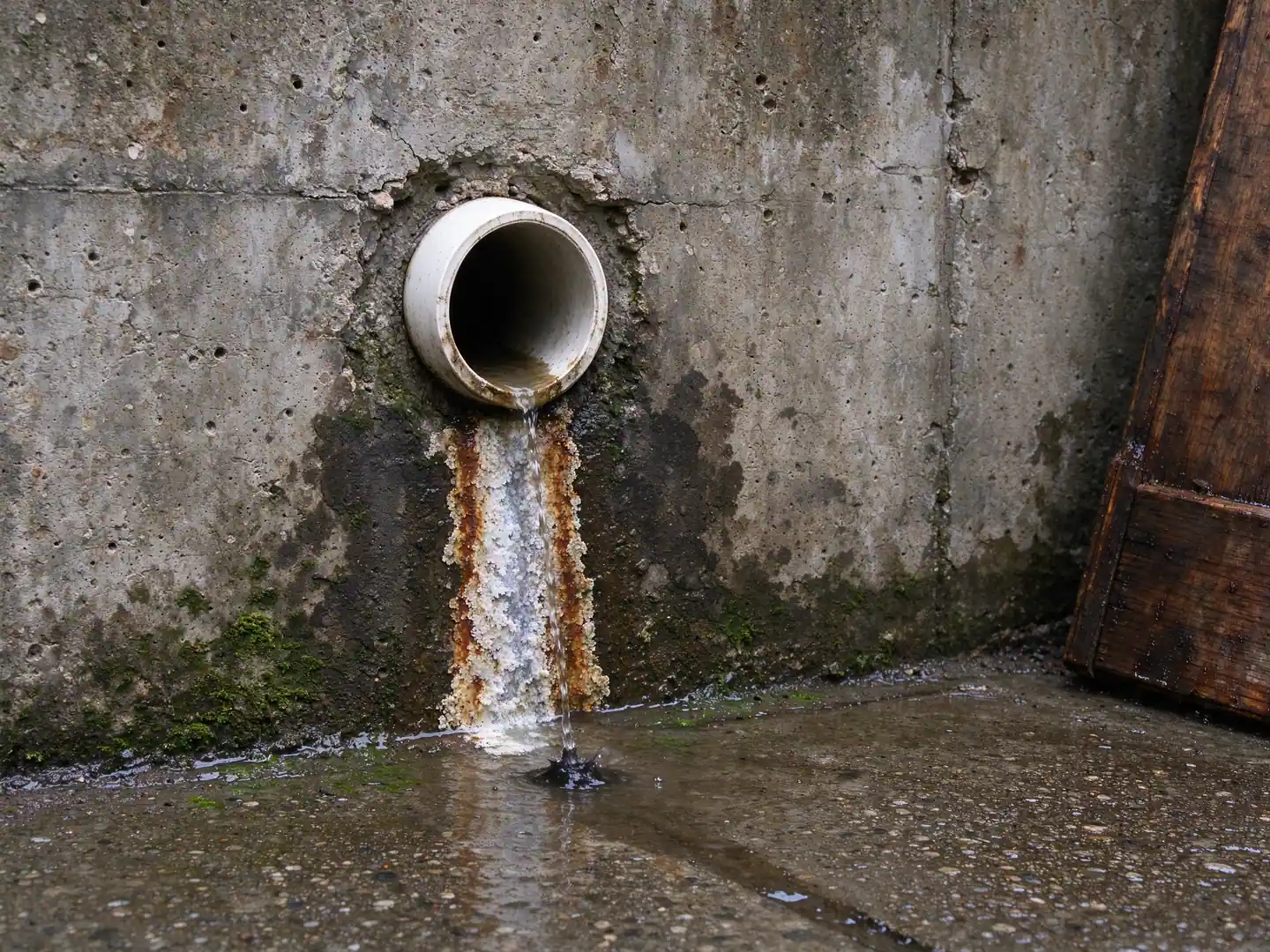
Retaining wall weep holes should drip or run after rain; that means the drainage behind the wall is working. If they stay dry while the face leaks, the soil stays soggy, or white mineral streaks spread across the wall, the drainage is likely clogged and water pressure is building. DOB lists clogged weep holes as a warning sign.
- DOB lists clogged weep holes and water pooling behind the wall as retaining wall warning signs.
- A saturated 6-ft wall carries roughly 1,100 lb of water pressure per linear ft (½ × 62.4 lb/ft³ × 6²).
- Hurricane Ida put 3.15 in of rain on Central Park in one hour on Sept 1, 2021 (NWS, via 6sqft).
- Drainage retrofit: about $90–$115 per sq ft in NYC (Fixr $70–$90 × RSMeans NYC index 129.1).
NYC Retaining Walls is a licensed and insured retaining wall contractor that repairs and retrofits retaining wall drainage across the five boroughs. Retaining wall weep holes are the small openings, usually pipes or gaps near the base of the wall, that let water drain out of the soil and stone behind it. They’re the only part of a wall’s drainage system you can see, which makes them the best early warning you have: when they stop working, water builds up behind the wall and pushes. Our retaining wall drainage repair page covers the fixes.
Why do weep holes matter so much?
Because water is heavy. Basic hydrostatics puts the pressure from water in fully saturated soil behind a 6-foot wall at roughly 1,100 pounds per linear foot of wall (½ × 62.4 lb/ft³ × 6 ft²), on top of the soil’s own push. A wall that drains never sees that load. A wall that doesn’t, sees it after every storm — and New York’s storms are getting heavier: Hurricane Ida dropped 3.15 inches on Central Park in one hour on September 1, 2021, and JFK took 8.65 inches in a single day on September 29, 2023 (NPR). DOB lists clogged weep holes and water pooling behind the wall among its retaining wall warning signs.
Which signs are urgent, and which aren’t?
Get it checked soon — the drainage has likely failed — if:
- Weep holes stay dry after heavy rain while the face of the wall is wet or dripping.
- Water runs from cracks, mortar joints or the base instead of the weep holes.
- Muddy water or soil comes out of the weep holes.
- The ground above the wall stays soggy for days, or puddles form at the top.
Call 311 and keep people back if any of that comes with:
- A lean, bulge or swelling at the base that’s new or getting worse.
- Fresh cracks in the soil or pavement at the top of the wall.
Normal — no action needed:
- Clear water dripping or running from the weep holes after rain, then stopping.
- A little green growth or damp staining right at the outlets.
White crusty streaks (efflorescence) are mineral salts left by water moving through masonry or concrete. On their own they’re cosmetic, but streaks spreading across the face mean water is taking a path it shouldn’t.
What clogs weep holes?
Usually one of four things: soil washing into drainage stone that had no filter fabric around it; mulch, leaves or roots blocking the outlets; outlets buried by regrading or a new planting bed; or no drainage stone behind the wall in the first place, so the holes connect to plain soil. In parts of southeast Queens, a groundwater table that has risen since local well pumping stopped in 1996 adds water from below (NYC Mayor’s Office; THE CITY) that an older wall’s drainage may not have been designed to handle.
How is retaining wall drainage fixed?
From smallest to largest job:
- Clear the outlets and flush them, if the stone behind them is still clean.
- Add weep holes by core-drilling through a solid concrete or mortared wall at the base, at regular spacing.
- Rebuild the drainage zone: excavate behind the wall, then install ¾-inch clean crushed stone wrapped in filter fabric, with a perforated pipe at the footing that daylights at the end of the wall or ties into a proper outlet. Redirect downspouts and surface runoff away from the top of the wall.
A drainage retrofit in NYC runs about $90–$115 per square foot (Fixr’s $70–$90 × RSMeans NYC index 129.1). If the wall has already moved, drainage alone won’t pull it back; it may need anchors as well — see leaning retaining wall repair. The repair cost guide prices the combinations, and the cost estimator gives a starting range.
Does a drainage fix need a permit?
Excavating behind a wall that’s 4 feet or taller from the top of the footing, or one supporting a driveway or slope, is structural work and generally needs a DOB permit with stamped plans (1 RCNY §101-14). Clearing outlets doesn’t. On the hillside lots of Staten Island and Riverdale, special-district rules can also apply to regrading. See retaining wall repair for how drainage fits into a full repair, and the wall assessment for a quick self-check.
Water coming out of the weep holes is good news; water coming out everywhere else, or nowhere at all, means the drainage needs attention before the pressure finds the wall's weakest point. To have your wall's drainage checked, (718) 555-0100.
Frequently asked questions.
Is it normal for water to come out of retaining wall weep holes?
Yes. That's their job. After rain, weep holes should drip or run for a while as water drains from the stone behind the wall. Clear water is fine. What's not normal: muddy water carrying soil (the fabric or stone behind may have failed), weep holes that stay dry after heavy rain while the face is wet, or water coming through cracks and joints instead.
Can I clean out clogged weep holes myself?
You can clear the outlet: pull out debris, roots or mulch, and flush gently with a garden hose. Don't drive rods deep into the wall or use a pressure washer at full force — you can push the clog further in or damage the filter behind it. If the holes clog again quickly, or soil comes out, the drainage stone or fabric behind the wall needs work, not just the outlets.
My retaining wall has no weep holes. Is that a problem?
Not always — some walls drain through a perforated pipe at the footing that daylights at the end of the wall, or through open joints in dry-laid stone or segmental block. But a solid concrete or mortared wall with no weep holes and no pipe has nowhere for water to go. Weep holes can be core-drilled into an existing wall as part of a drainage retrofit.
- NYC DOB — Retaining walls: information for property owners (warning signs)
- Turf Magazine — Drainage for retaining walls
- 6sqft — Hurricane Ida brings historic flash flooding to NYC (Sept 2021)
- Fixr — Retaining wall repair cost (updated Jan 31, 2025)
- THE CITY — Groundwater flooding in Southeast Queens (May 24, 2024)